


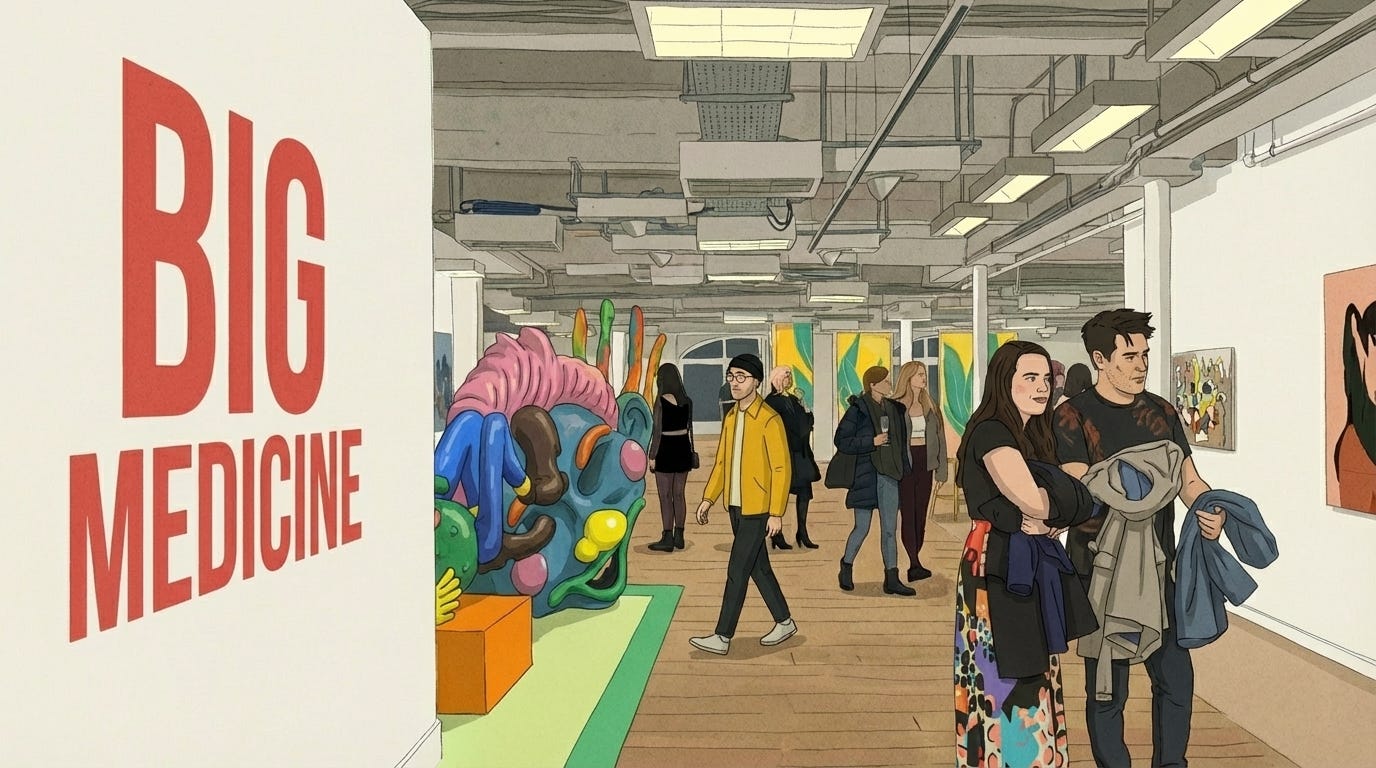
THE UNTOUCHABLES
“Get your filthy hands off our wall,” boomed the voice of an otherwise well-spoken gallerina sat behind the desk in one of London’s commercial galleries.
This was my first time in the capital city. And I’d never stepped foot in a place like this before.
My teenage heart sank towards my ripped jeans, and a wave of shame erupted towards my head, followed by a Heinz tomato-red flush of embarrassment across my face.
The fact was, people like me weren’t supposed to be here. We didn’t know how to behave in an art gallery. This very simply wasn’t for us.
Shove an ‘L’-shaped loser sign on my back and kick me out.
Nose down, eyes to the floor. Tail between my legs, I made an inconspicuous exit.
I never did get a close-up look at that painting I’d been desperate to study.
It’s not just me.
I’ve spoken to loads of people over the years who tell me they experience actual fear at the thought of going anywhere near an art gallery.
They physically shake approaching the steps of the Tate.
The one thing they all seem to have had in common is their class.
I get it. I’d have loved to have told you my introduction to the art scene was a warm and inviting one. But it wasn’t. It was brutal.
I didn’t know it at the time, but that moment would stay with me for the rest of my life.
POST COVID CRYSALIS
Let’s roll the clock forward a little bit.
It’s September, and it’s 2021.
The summer is still very much alive and kicking on the high street below my studio in the middle of Bournemouth. The huge arched windows give me a prime view of desperate shoppers beelining it for Primark.
Terrified eyes fear-scanning above chemical-warfare-level face coverings.
Everyone’s a stranger, in the strangest of times.
Desperately, they snagged some real-world dopamine and buyer’s remorse after an atomised Covid lockdown.
My whole studio had been working tirelessly for months and months on end.
Planning, making, building. Making posters, flyers, and shipping art from the far reaches of planet Earth.
Today was the day we would share what we’d been secretly building.
As I walked down the high street towards the recently defunct Debenhams department store (that the landlord had given us the keys to for free for a couple of years), I saw a massive queue for Wetherspoons. Obviously, the pub had some kind of free beer deal going on to get people back in. Old people, young people, people from every walk of life. The well-heeled and the art student, all politely placed with an eight-foot gap between them.
Waiting.
As I got closer towards the front of the queue, I saw Ben from my studio at the front of the line with a clipboard. Then the penny dropped. They weren’t queueing for a pint at all.
They were all here for the art.
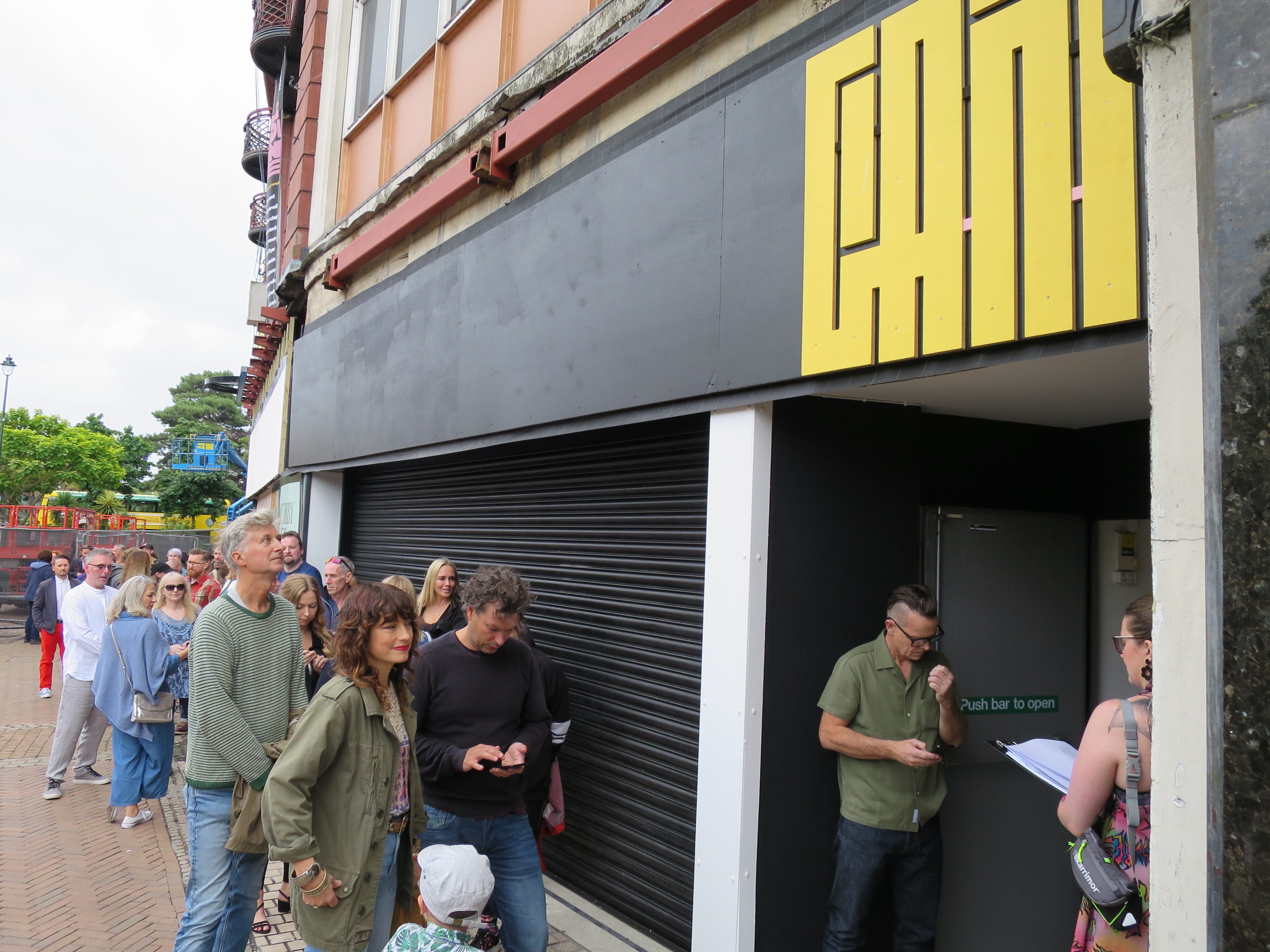
A queue around the block.
CAN’T GET TO THE ART MOUNTAIN?
WE’LL BRING IT TO YOU!
Small seaside towns like Bournemouth don’t have major contemporary art galleries.
Any right-thinking person will quickly tell you that it is because nobody really wants one.
This town is rotting amusement arcades, hen parties, and what’s left of nationwide chain stores peppered with the occasional vape shop or Turkish barbers.
Kids like me growing up here needed to make the pilgrimage to London to see anything. That’s if your family had any money for the train or the understanding that it might be worth doing in the first place.
Anyway, putting a whopping great gallery on the high street is exactly what we did. We took over the whole second floor of that department store, and we spent our last penny kitting it out. White walls, gift shop, reading room, and the best art we could possibly borrow.
We’d be open seven days a week, and entry would be totally free.
“How many are in there?” I sheepishly asked Ben.
“Hundreds, it’s one in one out,” he replied excitedly.
“Okay, I’m gonna…” I muttered, as we were interrupted by an older lady dressed to the nines for the occasion, pearl necklace and all.
“Is this the art gallery?” she politely quizzed.
“Yeah, but we’re full at the moment, so it’s about a fifty-minute wait,” Ben apologised.
“Don’t worry, dear, I’ve waited fifty years for this; another few minutes won’t hurt.”
She smiled, then dutifully took her position at the back of the line.
I stood at the bottom of the stairs.
Took a massive gulp of air and readied myself to go up.
I knew what we’d done was like landing a spaceship in the middle of a Greggs, and I was sick with terror.
If this didn’t work, I’d never recover.
THE PLAYING FIELD ISN’T LEVEL
Here in England, the vast majority of the population would define themselves as working class. It’s basically what most of us are. But the problem is, in the art world, we are still almost non-existent.
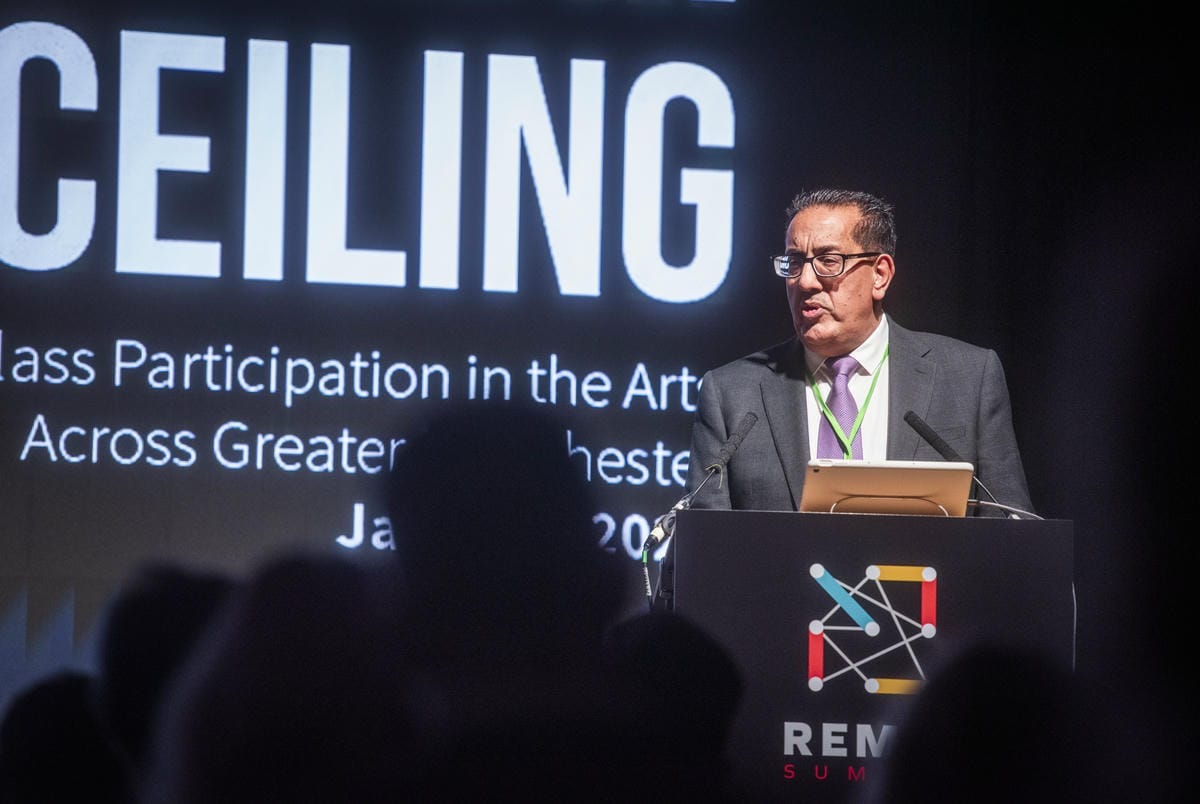
Nazir speaking at Remix summit in London
Back in January this year, Nazir Afzal and Avis Gilmore published a paper about working-class participation in the arts in Greater Manchester. I was booked to speak at the same conference as Nazir and sat there enthralled as his words floated from the podium. It felt like someone in the arts finally understood what it actually feels like to be me.
He didn’t sugarcoat it. He proclaimed it with a passion and venom that it called for.
“Working-class people experience discrimination in the creative industries.”
I don’t know why it cut so deep, but tears welled in my eyes. I felt the pain of hundreds of thousands of people like me who have been told for decades that they’re “not ready”, before sacrificing the empty carcass of their creative dreams and getting back in their place.
I’d love to tell you the experience as a teen in that London gallery was the only time my working-class upbringing was a problem. But it’s not. I’ve lost count of all the times people in the art world have made fun of my accent. Used phrases like “people like you” or made it their mission to knock me down a peg or two, back to where I belong. The times I’ve been curating a show and been treated like a janitor.
Not to mention how strange it feels to be in a tuxedo at a gala dinner with too much cutlery and some kind of esoteric eating ritual where, unless you’re an initiate, you are destined to fall into a bottomless pit of faux pas.
And the one that gets me most is what I call the “toff scoff”, a strange chuckle that’s half smirk, quarter chuckle and quarter some weird lip gesture I can’t explain. What it does is remind me that they are better than me, and no matter how hard I work, that will always be the case.
THE COLD HARD FACTS
Nazir and Avis’s paper, based on a survey of 300 creatives from working-class backgrounds, paints a stark picture.
More than half had experienced bias or prejudice because of their background.
Only 44% could afford to live from their work alone.
Less than 18% saw their lived experience reflected in the art they make.
That’s hardly surprising when just 8% of people working in the arts come from working-class backgrounds in the first place.
And it’s about to get worse. It was hard enough in my day to convince well-meaning family members that art school was worth it. Back then, we had grants. Now it’s loans. The average twenty-something leaving an arts degree is saddled with more than £55,000 of debt.
The truth is, the only people who would risk that are those who know that if it all goes wrong, they can call their dad and he’ll fix it. Obviously, they’re also the ones who already have the network and the resources to win anyway.
As Nazir wrapped up his speech to a tidal wave of applause, a light bulb went off inside my brain.
Twenty-five years of struggle, pain, failures and setbacks suddenly made sense. It wasn’t just bad luck. I was working in an industry that doesn’t want people like me.
And here’s the strange thing. Because I’ve managed to get somewhere in the arts, people presume I must be rich. That’s because everyone standing to the left and right of me usually is. The difference is I’m here through grit and hard work, and I want to hold the door open for others.
The system works exactly as designed. It keeps people out. We’ve been spoon-fed the idea that creativity is an equaliser and that talent rises to the top. It’s simply not true. The sorting hat of class has already pushed the undesirables onto the scrapheap long before talent gets a look in.
IT’S NOT DIVERSITY. IT’S POWER.
We tell ourselves it’s slowly getting better. The language changes. The right noises are made. But it isn’t. The slow boat is never coming.
Every young creative knows the deal. Fashion, photography, film, theatre, fine art. You take unpaid work to build a network. Privileged people start with that network already.
People from my background don’t feel entitled to any of it. We don’t ask. We muddle through and find a way. Most give up long before any breakthrough. And those who somehow hang on arrive exhausted.
The mad thing is that the creative spark that changes the world, the one that produced Maya Angelou, The Beatles, Tracey Emin, the Sex Pistols or Bob Dylan, doesn’t care what anyone inherited at birth.
Hand on my heart, I can say that there are some wonderful people in the arts who totally get it. I’ve had several legs-up from people who care over the years. Not least the legendary art dealer Anthony d’Offay. Sat on the floor upstairs in Derring St, he passed me Andy Warhol’s drawings of shop fronts whilst telling me “If Tracey (Emin) can make it here from Margate, you can make it from Bournemouth, my boy.” His quiet confidence in me and his belief were all I needed.
Since that day, I’ve promised that if I ever got anywhere at all, I’d hold the door open for others.
BACK TO GIANT.
Back at the bottom of the stairs, I said, “Right, Stuart, let’s do this” out loud before ignoring the sickening anxiety, ascending and then pushing open a pair of huge double doors to the space.
I called it GIANT because it was. 15,000 square feet. The entire second floor of the building. Our first show in the new space, ‘Big Medicine’, made the point that art might just be the cure we need to help us come back together in public space after the virus-induced armageddon that banished us to our Netflix ’n’ Chill bunkers.
I don’t know what I expected my first glimpse of GIANT to be; I’d been too engrossed in making it to think that far.
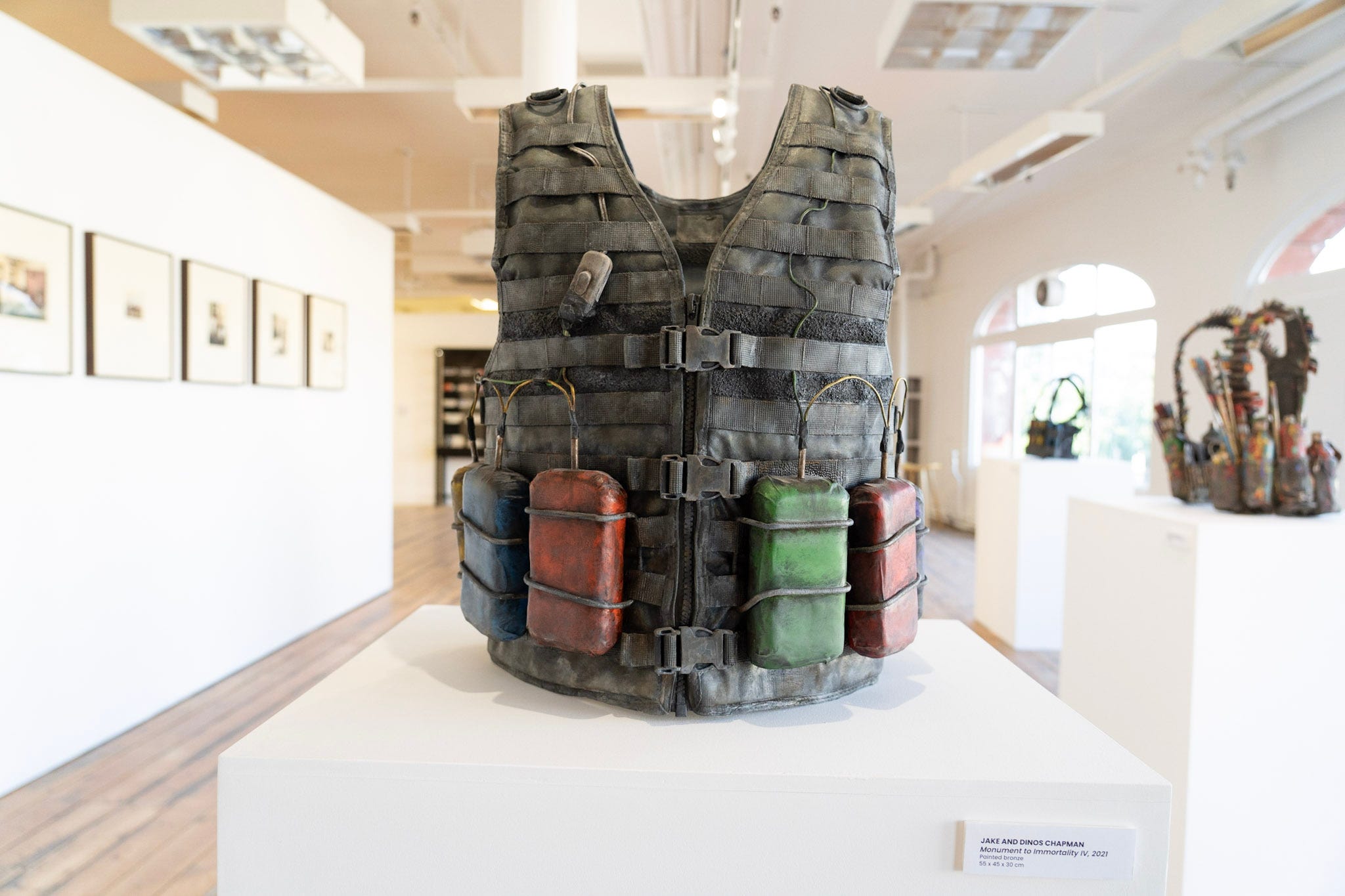
Jake and Dinos Chapman, monuments to immortality.
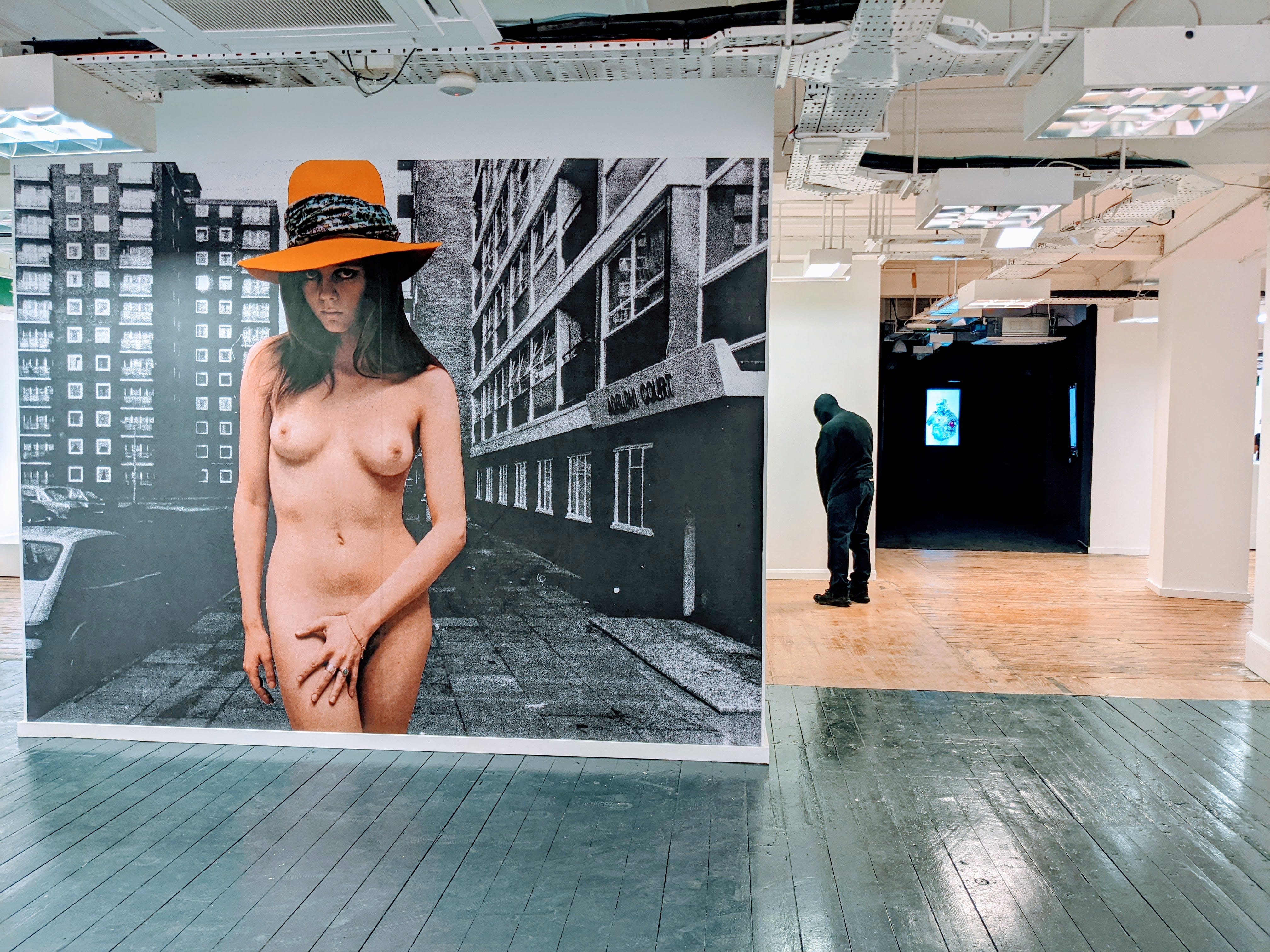
A monumental lifelike waxwork of a homeless man looked back at me from the other end of the gallery. He’d made his way here all the way from Australia, and at this distance, he looked the right size. Kids skipped on Jim Lambie’s zigzag neon vinyl floor that his studio team and local helpers had spent weeks installing, carefully tracing the edges of one of the gallery spaces. Quietly, couples contemplated the severity and sincerity of Jake and Dinos Chapman’s bronze suicide vests, weaving between pedestals, raising the hand-painted vests to eye height and asking us to look the horror of eternity in the face.
Sometimes private views have a palpable buzz. A sense that something is happening, that a moment is erupting, there’s a birth and you are witnessing it. The soundtrack of that, in this case, was an orchestra of squeaky sneakers on the polished reclaimed wooden floor, punctuated with knocks from hard heels and a morphing conversation made up of murmured discussion and excited celebration. It bounced off the sheer white walls that intersected the space, contradicting the leftover remnants of previous department store life. Vast in scale, and like a labyrinth of spaces and rooms.
Left to right: Sarah Hardachre, Mark Jenkins, Kenny Schachter.
The gift shop, designed by my friend who did the Design Museum store, was alive as well, and the reading area was already populated with students thumbing through the free library of arts periodicals. And the gigantic white-tiled front desk didn’t have any gallerinas; it was full of friendly gallery staff smiling in their uniform of Levi’s 501s and white GIANT logo T-shirts.
The atmosphere inside was electric. Mums, dads, OAPs, kids, students and everyone in between. They told me this wouldn’t work, but clearly it did.
The next day, national newspapers declared it ‘Saatchi on Sea’ and ‘Bournemouth Reborn’.
Then all hell broke loose. Tens upon tens of thousands of people descended, and it never stopped.
WE BLEW THE DOORS OFF
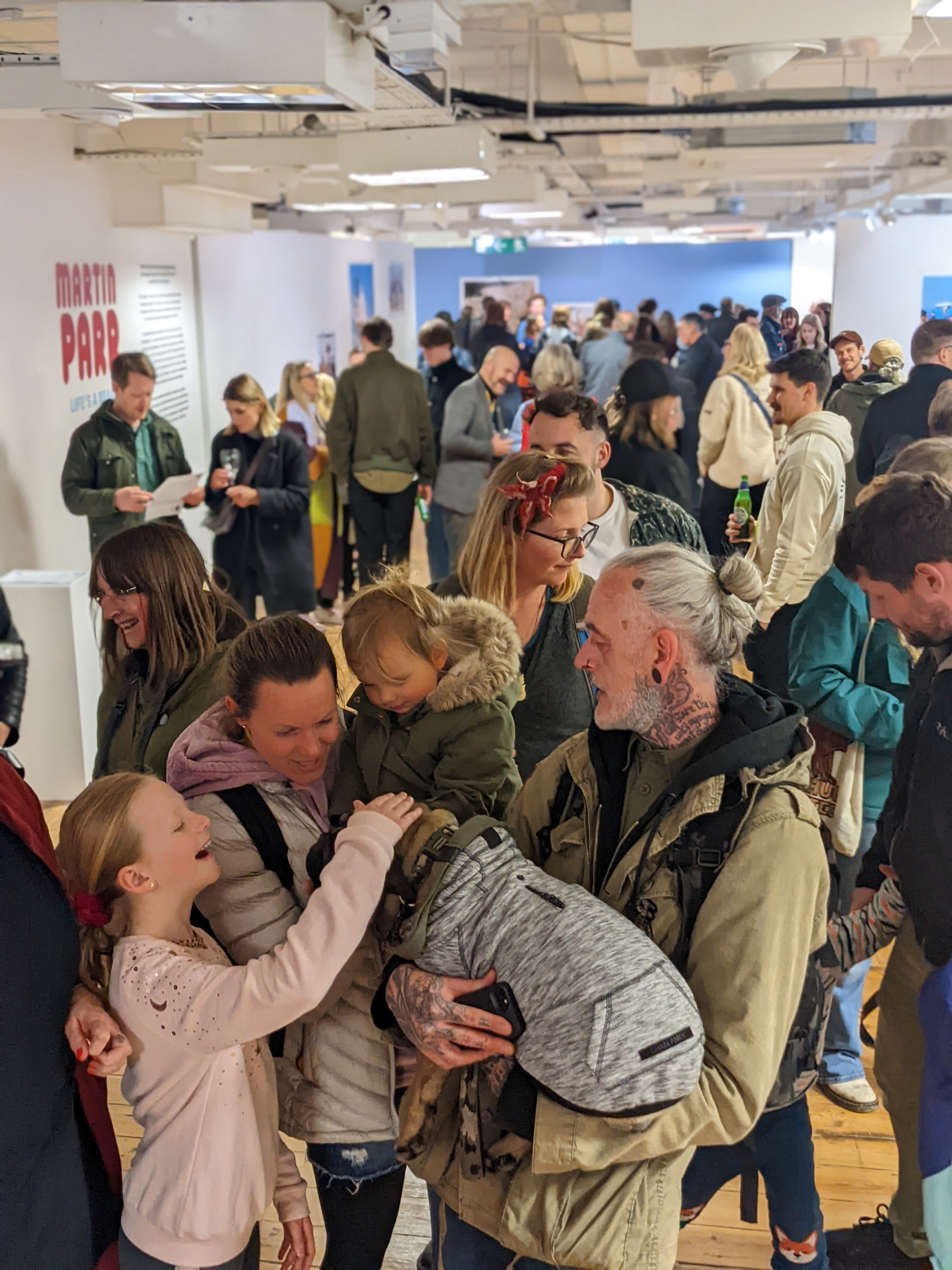
Our first show was a blockbuster. We had something like 25,000 visitors from across the UK.
I was astonished a few months into the show when both the local council and the Arts Council showed an interest. They could clearly see it was working, it was helping regenerate the high street, and it was good for tourism and local people too. They wanted to help keep it going. They’d contribute a portion towards our running costs for the next couple of years, until the end of the free tenancy.
Technicians, gallery managers, invigilators and a full-time education officer would join the mission.
We had major museum-scale shows by artists like Michael Simpson, Daniel Lismore and Sarah Maple. Group shows by guest curators with work by artists like Louise Bourgeois, Jordan Wolfson, Kenny Schachter, Gavin Turk and Tim and Sue Webster. We even ran a series of shows in our project space, providing a platform for curators. I even curated one of the last shows of Martin Parr’s photographs. His depictions of working-class life at the seaside brought the whole concept full circle.
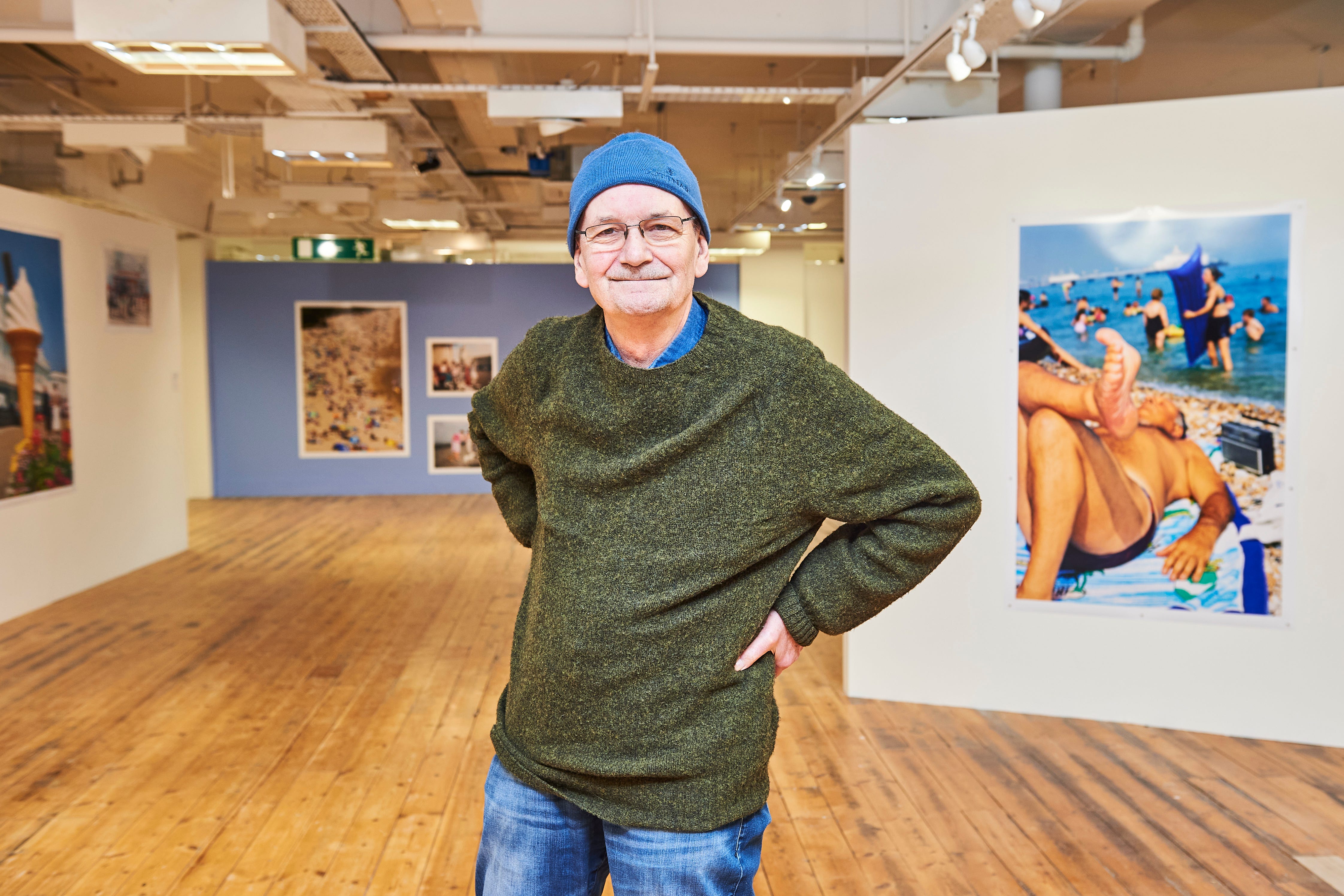
Martin Parr, at his opening.
In short, the hard work paid off. The staff had a proper, well-paid job for a couple of years, the artists had fees for their work, and curators were supported to bring their ideas to life, even young ones who’d never done it before. No exhibition ever had fewer than 15,000 visitors.
Over the next couple of years, hundreds of thousands of visitors walked through those doors without paying a penny. They entered through the gift shop, and before they knew where they were, they were confronted with proper contemporary art.
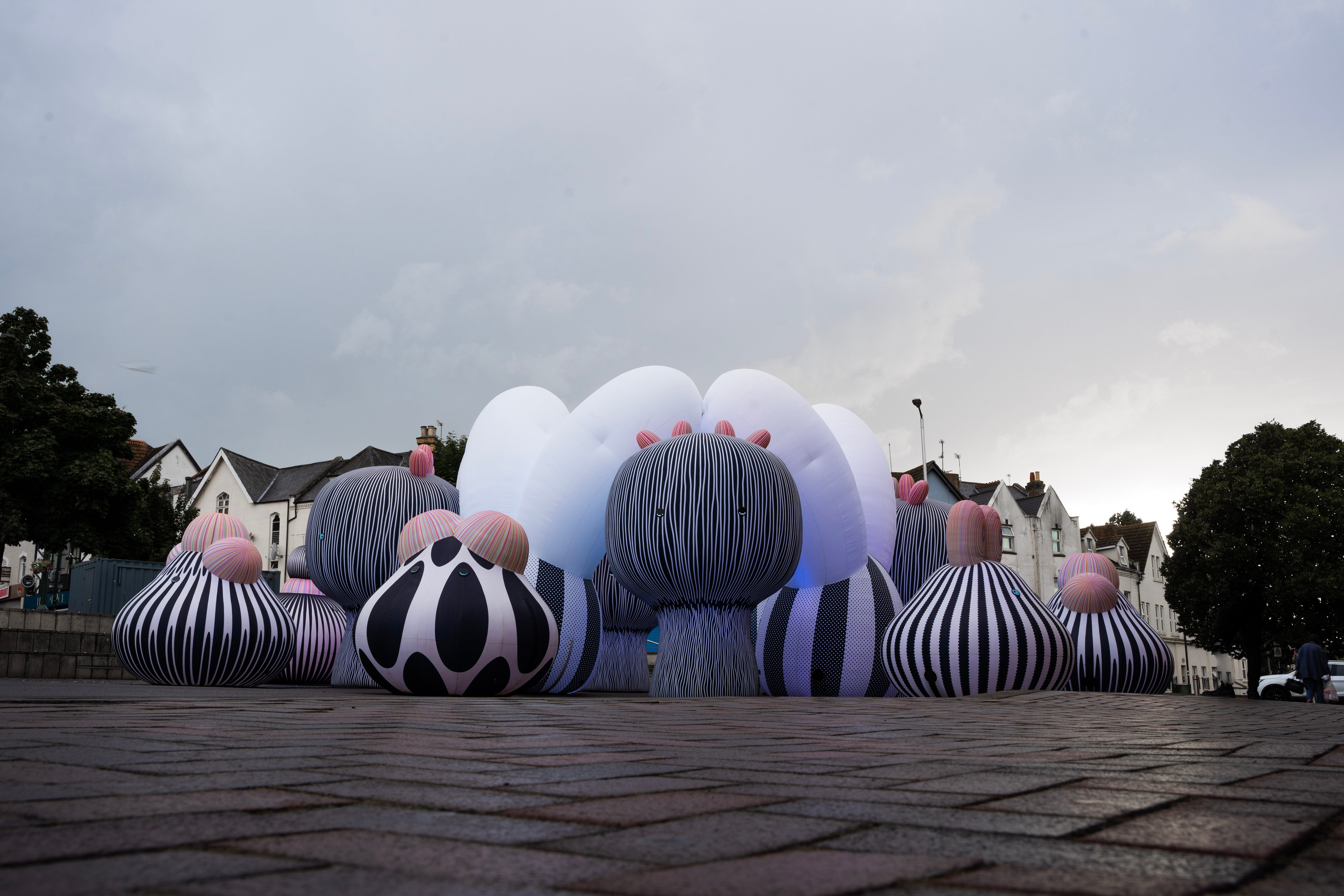
We brought Jimmy Cauty’s (from the KLF) Estate artwork to the high street as an off-site project, and even presented ENESS’s inflatable sculpture all the way from Australia. We hosted music nights, brought in an art opera, and put on bands and performances. Bournemouth had a very arty few years.
School kids would sit cross-legged, drawing. Regulars would hang out in the reading room. A community developed, and hundreds of new friends would reconnect at opening receptions.
But the real success was the education piece. Emma, our education officer, left no stone unturned, encouraging families, older people and children into the space and giving them a way to understand what they were part of. She even took the work we did out into schools.
The true heroes of GIANT weren’t me. I just got the ball rolling and curated a couple of shows, lined up the space and sunk my life savings into it.
It was the day-to-day team that kept the wheels on against the backdrop of all kinds of insanity. MPs demanded it was shut down for indecency, the landlord moved walls while we were closed, or suddenly shut the space for weeks of maintenance.
Amanda greeted everyone who walked in with her warm smile and kind explanations of the work. Ben, the technician, could install anything and make it look a million dollars. Video rooms, installations of hanging crystals, and paintings. And with his buddy Finatan, they would transform the space between shows to look like an entirely new gallery. New walls, colours, plinths, projections, no problem. Their hard work made it look exactly like a high-end gallery should.
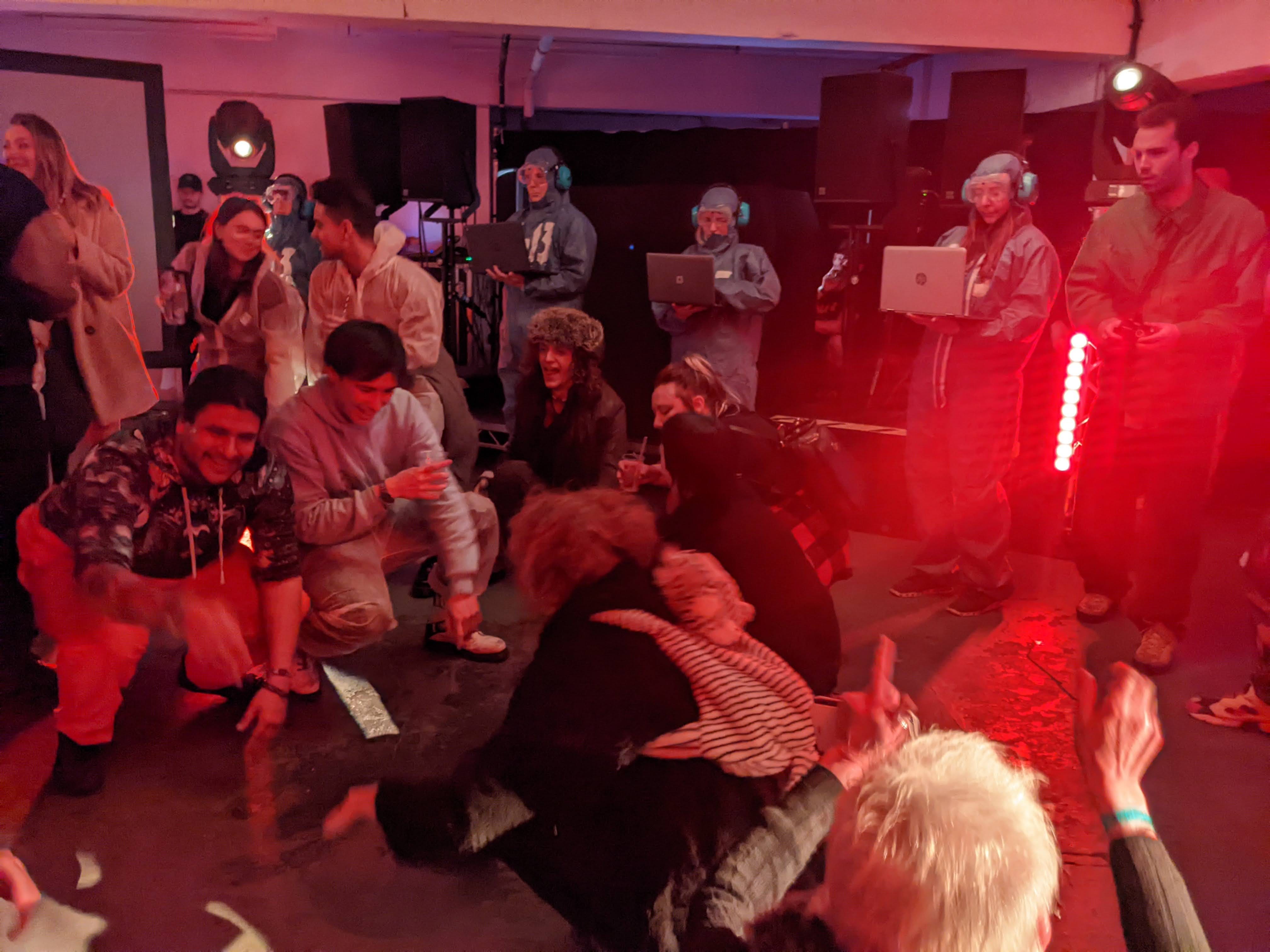
The army of invigilators guarded the work and supported visitors day in, day out. Policing a gigantic rabbit warren of spaces with complicated objects in them is no easy feat, especially when Bournemouth art lovers want to touch everything.
Underneath that, the gift from the goddess was Verity, an angel in a gallery manager’s clothing, who made sure everything ran properly. It was a dream that, unfortunately, only had a couple of years of runway. Most artist-run spaces are there for a good time, not a long one.
We did good, we proved it.
But the landlord always told us he’d need to renovate the space.
WE (SORT OF) WON THE LOTTERY
If you manage to bag that unicorn in the form of elusive support from the Arts Council, not only is it a badge of honour, but it’s also not exactly how most people imagine it.
Just because it’s lottery funding doesn’t mean the minute you’re approved a giant hand comes down from the sky declaring “it’s you”, and then a nice lady turns up with a humongous comedy check, pearly whites and a handshake paparazzi moment.
No, as anyone who’s ever had a project grant will tell you, the check is divided into several smaller bite-sized chunks. In our case, delivered at an unpredictable schedule over the next two years. The first would take about six months to appear, and the last would be well after our tenancy ended. No serving is guaranteed, and each is based on a progress report. Quite right too, of course. It is the public purse after all, and if they gave out grants willy-nilly, the UK government would have their guts for garters.
The clandestine curtain of public funding is nothing I’d had to face before. Outside it, organisation directors patiently wait for the gloved hand of Oz to emerge, hopefully with the next grant instalment. Like a watched kettle that never boils, the steamy apparition never appears when you need it. Sometimes it comes without support at all, only a laundry list of questions, our answers snatched back into timeless opacity. There’s no use banging on the curtain even if you’re struggling; it’s a one-way process.
Before they even give you a grant, they check you have some resources of your own to contribute should everything go wrong. That excludes most people from doing something like this straight off the bat.
MONEY WHERE MY MOUTH IS
The fact is, I ended up ploughing my last penny into it to get it through to the end of the programme.
The Arts Council and the local council were incredibly supportive. They really got what we were doing, and their advice was often worth more than the funding. Sometimes, a little bit of belief and a cheerleader is worth its weight in gold.
I often found myself between a rock and a hard place, committed to a programme of shows, artists and curators. Loans had been secured, work was being transported from overseas, and contracts with staff and insurers were set in stone. Not to mention the advertising and marketing that is planned months ahead of an exhibition. If you’ve told the world you’re doing something, you have to do it. You can’t just put the brakes on until your grant arrives.
When you shake hands with the public purse, you are personally on the hook.
In our case, over those two years, there were even a couple of moments where some of the team were paid a couple of days late. Of course, we all made it through, and it was worth it, but it wasn’t easy for anyone.
I ended up giving nearly £140,000 to the project, more than I ever expected, at times, everything I had in the world, often at the expense of the rent on my home. It was totally worth it, and I’d do it again at the drop of a hat.
CIVILIZED SANDWITCHES.
I’m not sure when Ben and I signed up for the Antiques Roadshow, but the great British public seemed to have decided we did.
We stood behind a table in the project space, ready and excited to see what the good people of Bournemouth would bring in to show us. We’d come up with an idea that our last ever show in the space would be an ‘open’, linked to the Dorset Arts Prize in collaboration with the local art college.
We’d meet every single person who brought something in, give them an on-the-spot crit and hopefully some helpful feedback. If we liked the work, we’d hang on to it and put it in the show.
And bring work they did, thick and fast.
We looked up and the gallery manager was hopping up and down, waving her arms about like a mime artiste trying to subtly signal that a comet was coming.
I told Ben to hang on whilst I assessed the situation.
Then began my reconnaissance mission.
I followed the line out of the project space and all the way through the main gallery.
Hundreds of people, some with fold-out chairs, others with sandwiches. Young ones, old ones, ones in between. Lively discussions about their work, camaraderie at the pain of having to wait so long to be seen.
I kept going, all the way down the stairs, all two flights, and out into the street and on again around the outside of the building. Hundreds and hundreds of people from far and wide, with every kind of imaginable art possible.
Once back upstairs, I looked at Ben, terrified.
“There’s thousands of them, Ben.”
“What are we going to do about it?” he asked.
“Fill the flipping walls up,” I replied. “Let’s take the lot from now on, as much as we can fit. It’s their gallery anyway.”
It took us several days to hang that show, like a cryptic Tetris.
Paintings, ceramics, video work, tapestries. You name the art form, we had to work out how to include it.
At the end, we left no work unhung.
But like almost every artist-run space, we were there for a good time, not a long one, and the opening reception of ‘The Open’ was also the real closing of the gallery.
There were tears, lots of them.
I didn’t make a speech that night. It didn’t feel right. It was never about me. GIANT was everyone who came, everyone who contributed and the community it served.
Exactly 28 months after the first night, Ben turned the lights off for the final time. He left through the back door carrying the last bin bag of rubbish. Art had officially left the building.
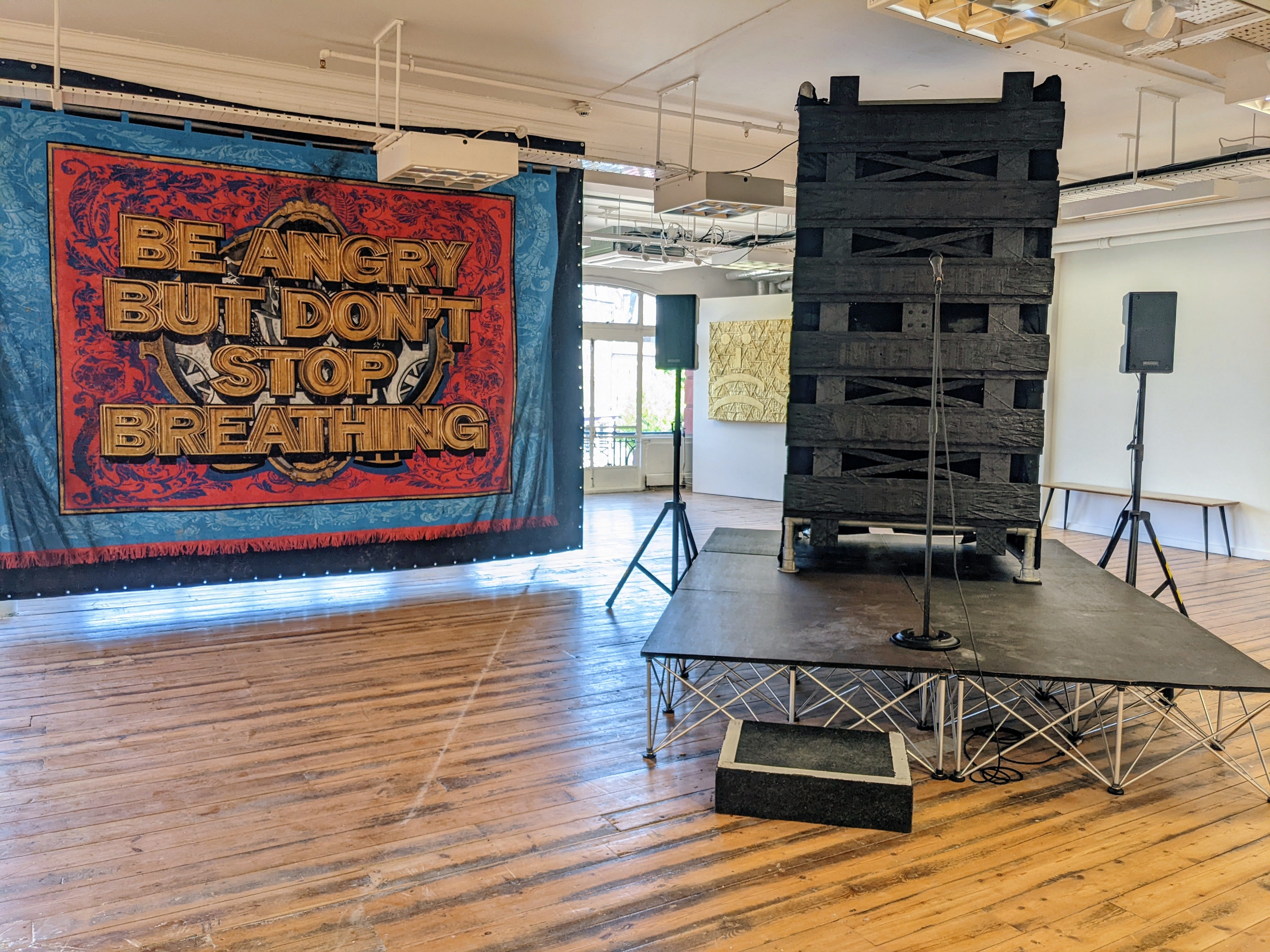
Mark Tichner installation
On my way out, I watched a young boy running laps around a Mark Titchner installation. His dad smiled and crouched as the child boomeranged back into open arms.
He whispered,
“If you keep up with your art, maybe one day your stuff will be in here.”
Read more from The Diary of an Artist:
https://www.diaryofanartist.co.uk/