



The bamboo whisk finishes its job in my matcha bowl, leaving the perfect froth as I pop it back on the wooden table in my studio. I sit back in my armchair and carry on with a lockdown video that Yale made with Peter Doig talking about his paintings, only to be rudely interrupted by one of my studio assistants storming in and slamming a bottle of magenta paint next to my tea.
“What the feck is this?” they scream.
“It’s a lie, magenta doesn’t exist!”
“I’ve heard all about it on Reddit.”
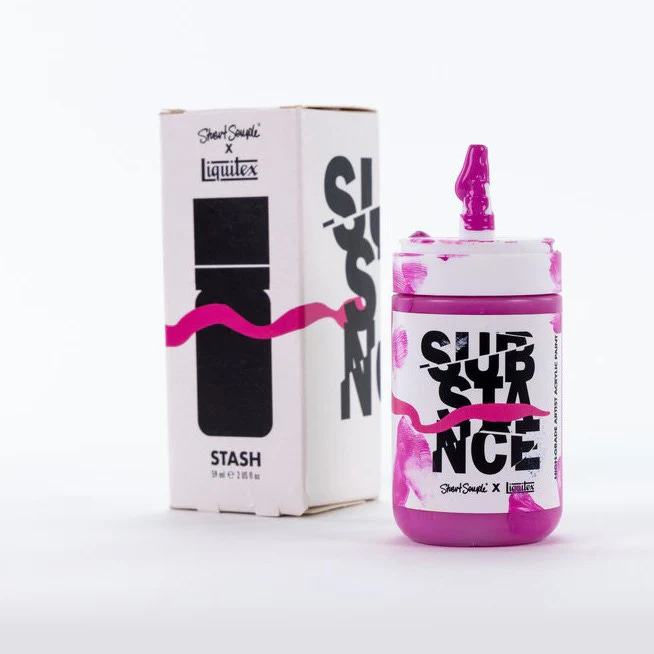
‘Stash’ Stuart Semple for Liquitex
Obviously, it’s not the first time someone on Reddit has the story a bit twisted, not least because this bottle of ‘Stash’ acrylic that I made with my friends at Liquitex for other artists to use is very, very magenta and very, very real.
I pull up a chair, invite my uninvited guest to take a perch. I slurp the green elixir from the bowl and end with a customary lip smack.
“Okay, I need to share a secret with you. It goes deeper than that. It exists, but it doesn’t exist out there, in the world.” I point across the room and lower my voice to a whisper. “It only exists in our mind, but the experience of it does exist.”
Let’s talk about colour. Properly, and if I do this right, you’ll get what it is quickly and understand exactly what’s really going on.
SHINING A LIGHT ON COLOUR
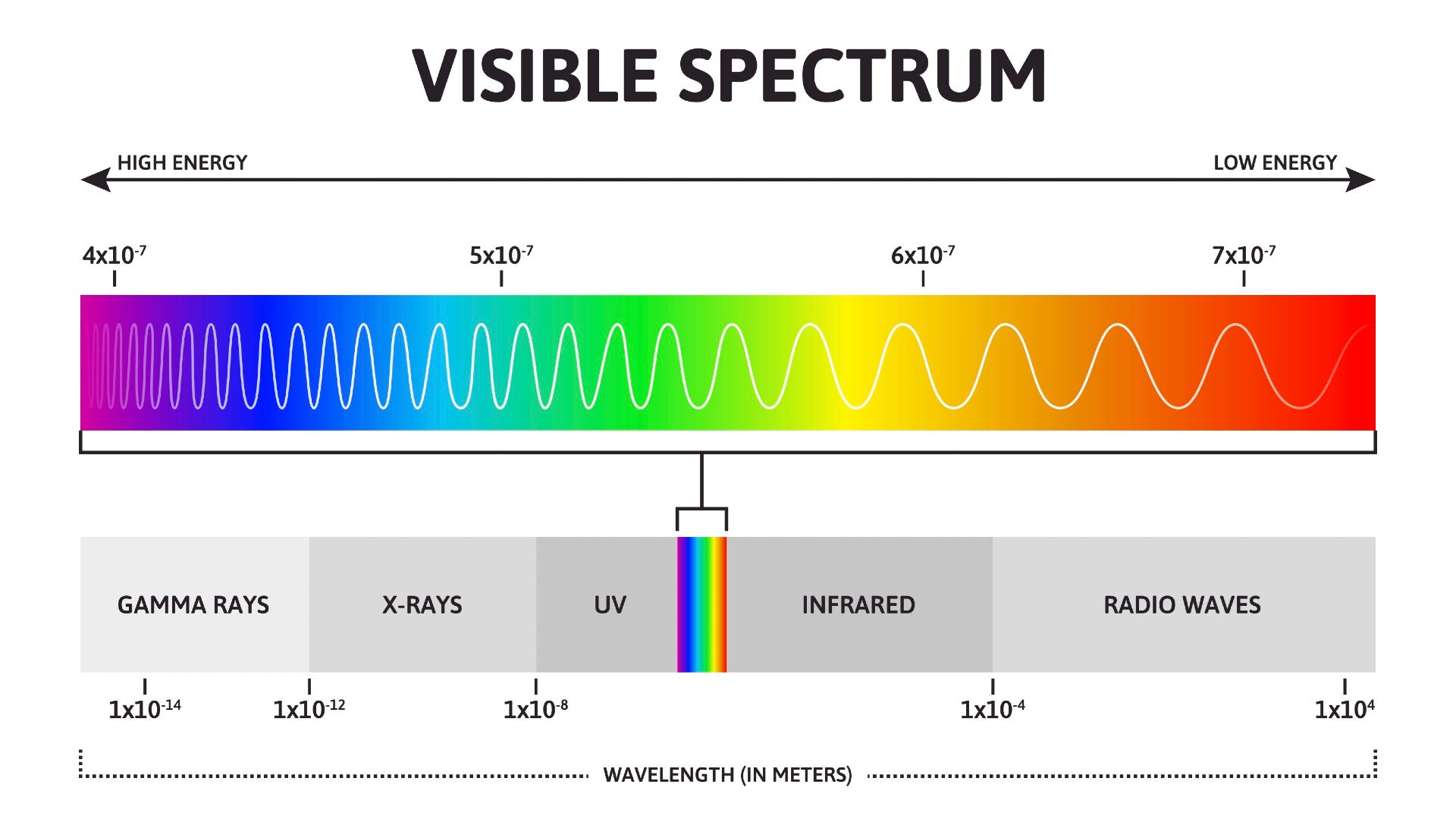
First thing, and a bit annoying (sorry). There are really two different types of colour.
The first one is all about ‘electromagnetic wavelengths’. I know! But just think of it like this, there are these kinds of vibrations going on all the time. Most of them we can’t really see, like your WiFi, or the microwaves in your microwave! Or even the beams from the sun that give you a tan or make things hot. They’re invisible.
But there is a small bit inside all of those wavelengths that you and I can see with our eyes. This is what we call the visible spectrum. It’s a bit like a rainbow, and we’ve got red at one end and violet at the other. We often divide it into colour bands, but really it’s continuous. After the red that we can see, we get red we can’t see (infrared), and then after the violet we get ultraviolet. Infrared is strongly associated with heat, which is why it feels warm. You probably know your dog, bats, and different animals can see different bits of the spectrum.
Got it. Type of colour number one, visible light spectrum.
THE COLOUR OF THINGS
Now, type of colour number two, the colour of stuff. Leaves are green, bananas are yellow, the sky is blue, and my ex-girlfriend’s heart is black, black as the night.
Here’s how it works. Light hits an object.
To keep this easy, let’s take it as a white light, which contains all of the visible spectrum, the full spread. Then the object absorbs some wavelengths of light, and some of them are reflected back to your eyes. So a red apple is absorbing everything apart from red. The red comes back to your eye, you’ve got these little rods and cones in there, they do some magic, and your brain makes sense of it. There’s a lot to that, but that’s a story for another day.
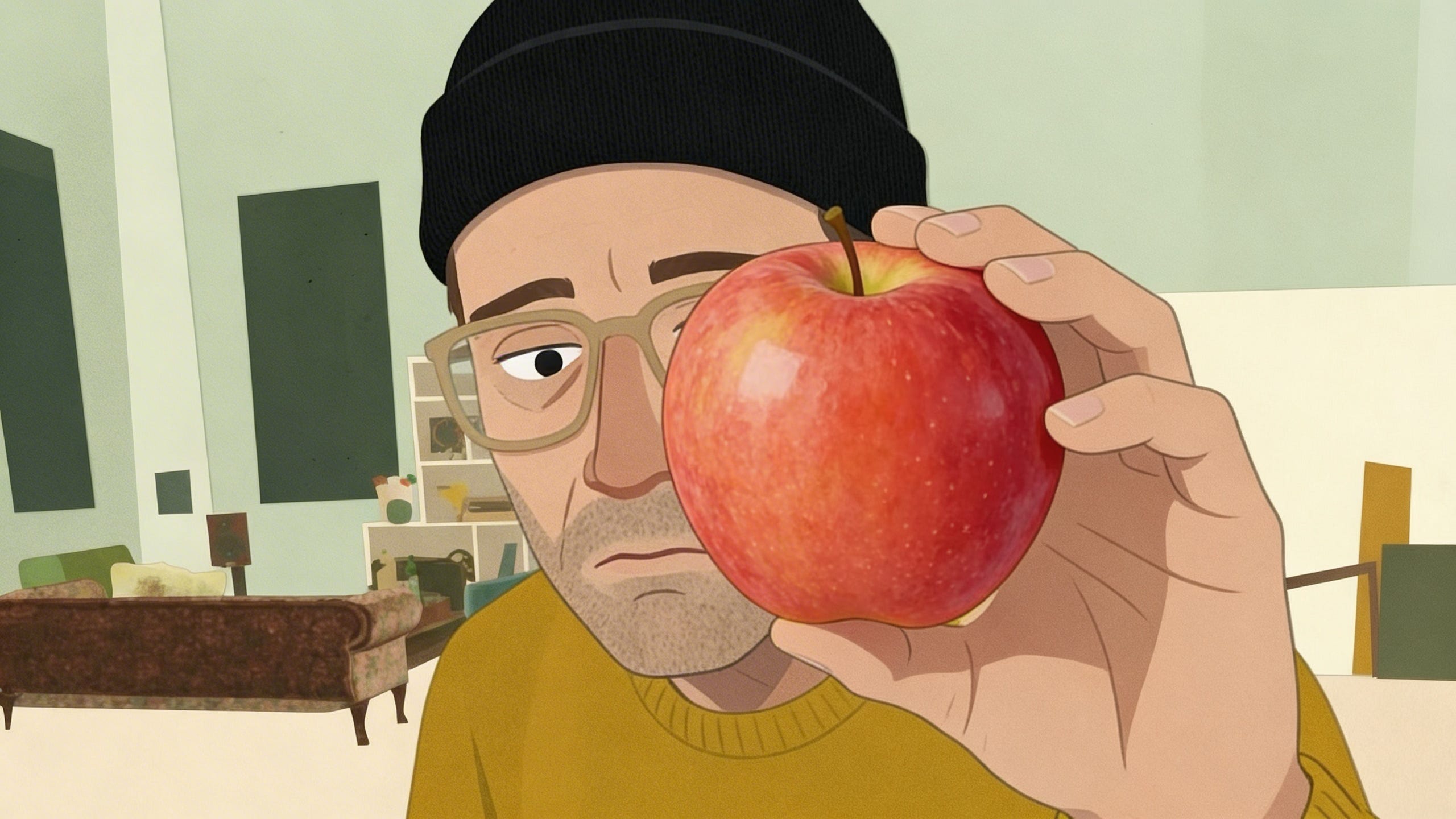
You can confidently say “that is a red apple”.
So this is working through pigmentation, and as artists, we know pigments well. They’re the basis of our paints, and our graphics friends understand them perhaps as inks we use to print things. A simple way to think of it is real physical stuff that absorbs specific light frequencies.
Grab some ultramarine pigment; it’s going to suck everything up apart from the blue.
“Yeah, yeah, but magenta isn’t on that visual spectrum,” my slightly confused guest prods. “It’s not really out there at all then, is it?”
No, it isn’t, because it’s not part of that first kind of colour, you can’t specifically find it in the visible light spectrum as a single wavelength. Absolutely right.
“So how come you’ve got a bottle of it there then, how on earth can I see it?”
MAKING MAGENTA
Well, it’s easy, we use a magenta pigment in the paint. Magenta pigments exist; they absorb green light and reflect a mix of red and blue wavelengths that your brain interprets as magenta.
“Oh, so it’s a mixture of other colours?”
Not quite. It’s a primary colour in some systems. Remember at school how your teacher told you you could mix red, yellow, and blue together to make all the colours? Well, she wasn’t exactly being straight with you.
In the first kind of colour, light, if you mix all the red, all the green, and all the blue, you actually get white. That’s how screens work! They light up red, green, and blue pixels.
You know the fastest way to make a mucky brown is to mix your red, yellow, and blue paint.
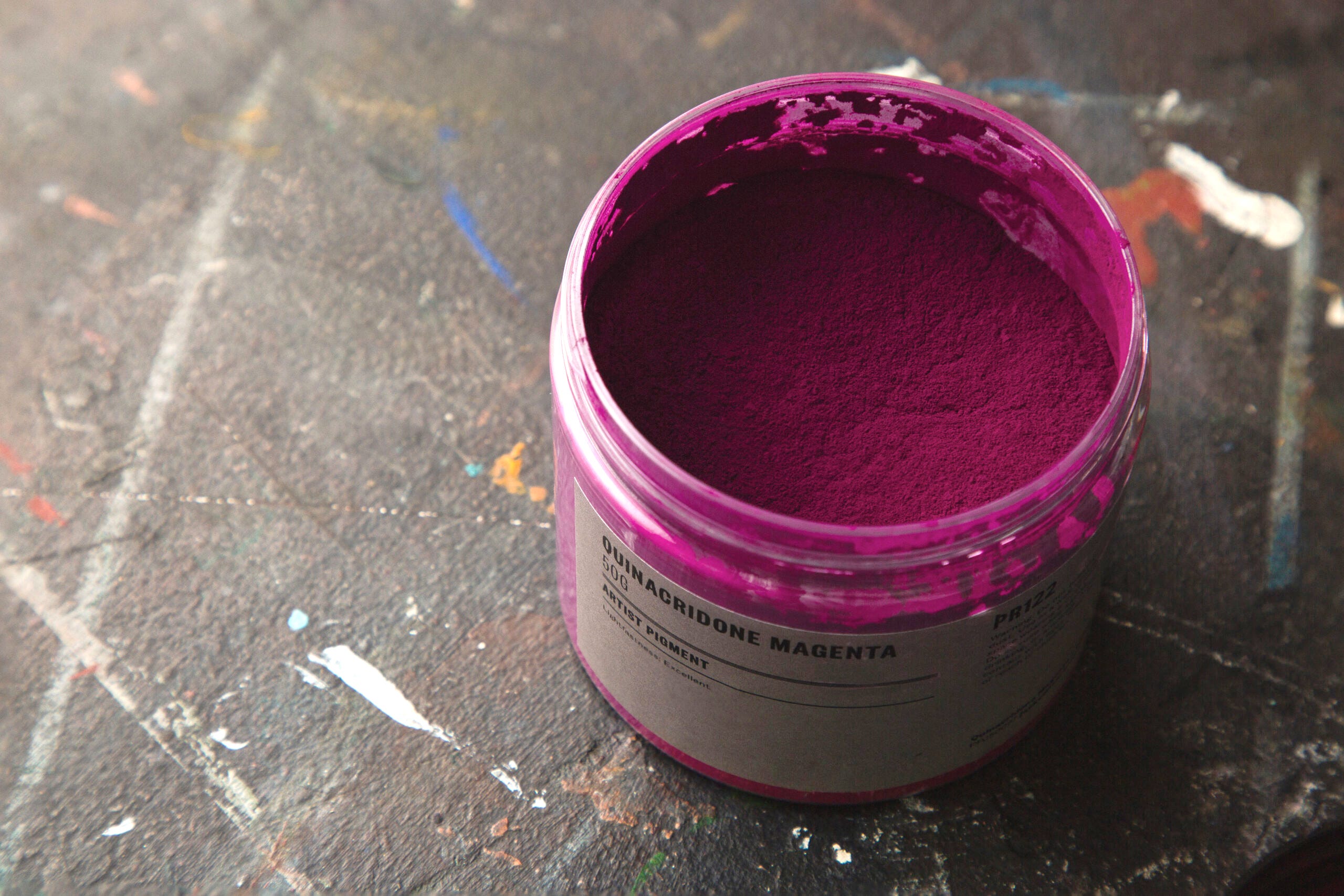
So no, you can’t make a true magenta out of red, yellow, and blue paint exactly. Back in the early 20th century, we developed quinacridone pigments but didn’t really get our heads around producing them industrially until the 1950s. So it’s quite new. Anyway, we fuel pretty much most of our magenta paint and printing with it.
Another easy way to think about all this is that in the physical world, with printing, they use different primary colours than your teacher told you about. Not the kind that we mentioned in the first kind of colour, the light spectrum. But the second kind, the kind that is real physical stuff that soaks up light. In printing, they use cyan, magenta, yellow, and black. So in that system, magenta is a primary, which means you can’t mix something else to make it cleanly. But you can combine the cyan, magenta, yellow, and black to make loads and loads of different colours.
THE EYES HAVE IT
Although your eyes can only distinguish 10 million different ones, and that’s if they are super healthy. I’ve not got the best eyesight, so I reckon I’m down to about a million.
“Look, mate, I’m definitely experiencing magenta when I look at that bottle, and it’s not in the visible spectrum, I’m surely not imagining it?”
Well, you kind of are. You’ve got these cones in the back of your eye, that I mentioned before, and they are wired to sense red, green, and blue. They can’t pick up ‘magenta’ because it’s not in the visible spectrum, so what’s happening is that this magenta paint is absorbing lots of green and that means the cones in the back of your eye are sensing lots of red and lots of blue. When the red and blue signals are strong and the green is weak, there’s no real colour that fits, so the brain makes one and calls it magenta.
“So basically, Reddit was right, and magenta isn’t real, I said that in the first place.”
EXPERIENCES EXIST AS EXPERIENCES
Even though we can’t put a pin in the visible spectrum and say “there, that’s magenta,” because it’s not there, the experience of magenta is 100% real.
I hand my visitor the Liquitex paint. “You can keep it. Colour lesson over.”
I press the spacebar on my laptop and transport myself back to Peter Doig, explaining why it takes him years and years to make a painting, whilst suddenly seeing all the very real magenta in his works.