


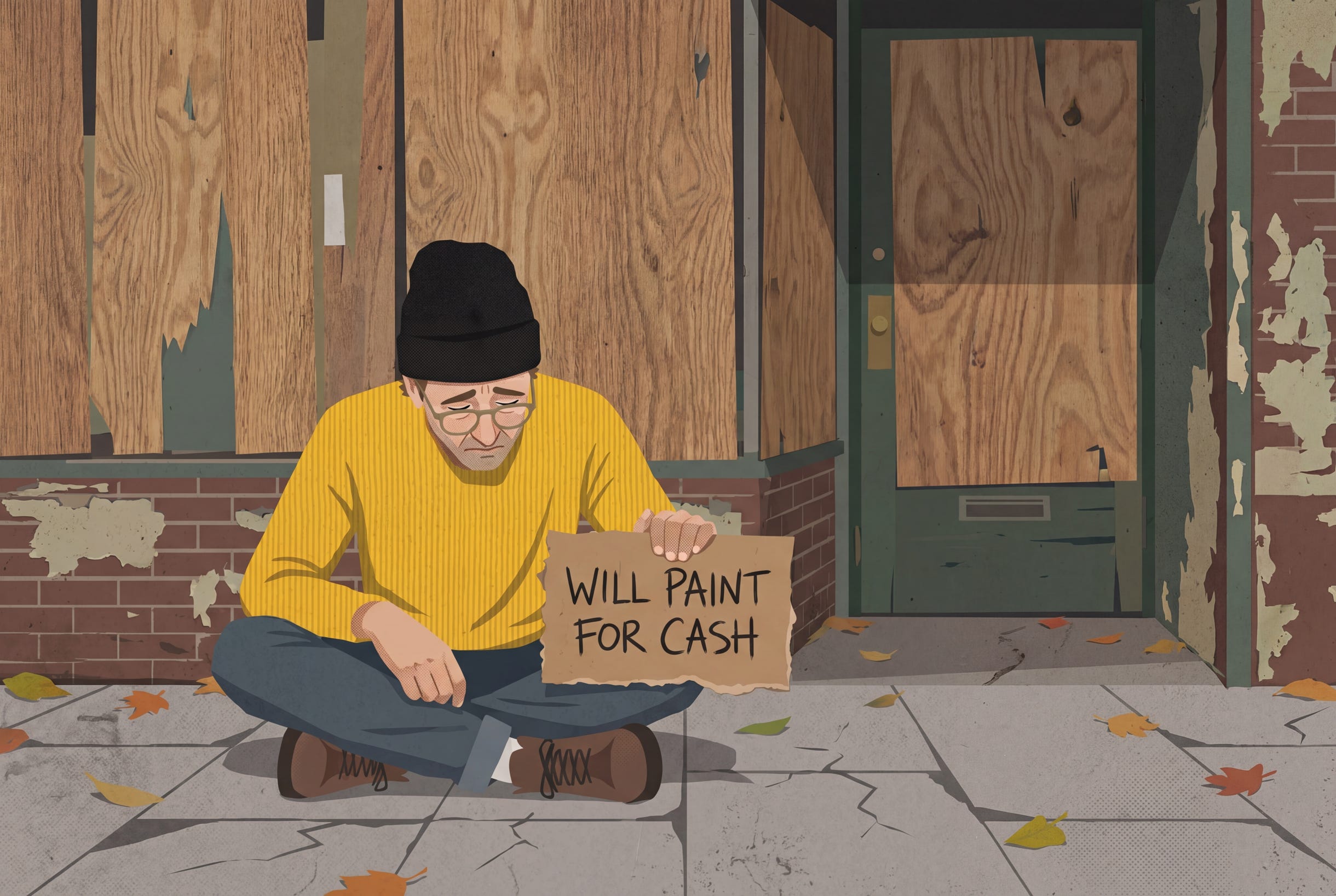
The gallery is packed, but I’m not there yet. I’m in the toilet, throwing up with the anxiety of walking in. The last twelve months have been spent in hermit-like isolation, doing my best to make some paintings I don’t completely hate. In ten minutes, I’d know if it was all worth it.
ON THE FENCE
So how do we decide what artistic success looks like? Is there a singular metric, outcome or condition that we can use to declare a winner or a loser?
The media obviously uses money as the gauge. An impressive price attached to an artwork still (almost) guarantees that it will reach escape velocity in the art pages and hit actual news.
You already know the argument. The value of something and the price of something aren’t the same thing. The love of your dog, the feeling you get when you watch your baby sleep, or a sunset. All free and all arguably priceless. Cue the clichéd tropes: she who dies with the most toys still dies, money can’t buy love, and the best things in life are free.
Fundamentally, art is an experience. And how you feel about something and how I feel about something are probably unique. You’re moved to tears by Coldplay, and I’m crying in pain begging you to turn it off. Rothko is just a few blocks of colour that your auntie could paint to someone, and to another, looking at one is a transcendental experience. And all of this is before we muddy the water by adding in the myth of the person who made the stuff in the first place.
Does a new album sound different because Kanye made it? Are we even capable of discussing his work with the same depth as we discuss one of his offensive tweets? Does Jeff Koons have more to prove than someone starting out? Do we treat Bob Dylan differently because he finally got his Nobel Prize for Literature, or is he a Judas dressed as a charlatan?
Even the critics can’t really help. Their opinion is just that, an opinion. So many artists, me included, have done so much to prioritise experience over object, to escape the siren call of capitalism’s treadmill and make art for the sake of it: Kaprow, Abramović, even John and Yoko. But the system we are in is, very sadly, the system we are in.
The sad fact is that outside the bubble of art, in the minds of the world, we need a system to weigh, measure, quantify and decide. The default is price.
Even countries publish their GDP, how much they generated, like it’s some kind of accolade. Some of us have been banging the drum for measuring happiness rather than cash. When we do that, we see instantly that some of the poorest nations are the happiest and vice versa.
MY 5-YEAR-OLD RABBIT COULD HAVE DONE THAT
I work in a call centre. 9 pm till 5 am. It’s the graveyard shift, and all I get is grief from people whose internet-enabled fridges have gone rogue and decided to take over the home. Normally, I tell them to switch it off and on again. I saw a toilet in a gallery once. Someone told me it was worth millions. That’s not fair. Anyone could do it. It’s obviously a scam. Someone should expose artists.
The allegations are as follows. You don’t have a proper job. You’re conning people into believing it’s important. It’s not fair, and you must be doing something illegal somewhere to get away with it. You artists are having something else on your cornflakes in the morning. My 5-year-old rabbit could have done that in 2 minutes, even though it’s blind. Modern art is rubbish.
DEALING RED DOTS
Back at the show, I’ve finally steadied myself enough to emerge from my toilet cubicle cocoon. The butterflies in my stomach are evil black moths with fangs. I walk into the show. Everyone is lovely. They come up and say the exact same thing. “Congratulations, great show.” I always thank them, but it doesn’t really settle the one thing I’ll never know. Is it any good?
I started to notice little red dot stickers on the walls next to almost everything I painted. A dot means it’s sold. Half a dot means it’s reserved. To be plain, it probably won’t sell.
I hate the dot thing. It’s cheesy, way too much about the money. I swear, people are more interested in how many works have been sold than they are in actually looking at the work.
The dealer sees me from across the room, comes over and puts his hand on my back. I’ve been sharing images of the work with him all year. We’ve spent days together hanging this. For me, it’s the moment where my insides are judged by other people’s outsides. For him, it’s make or break on paying his staff, keeping the lights on and paying the gallery rent. Plus, that massive art fair on the other side of the world, he needs to fly his team and the art out to.
He whispers, “It’s pretty much sold out, it’s a knockout, we’ve got a feeding frenzy.” But for some reason, the rioting moths in my belly are still revolting.
“That’s great,” I mumble, “do you think anyone understands it?”
Before I know it, he’s introducing me to someone, followed by someone else. A flow of “Congratulations” and “Thank you so much” runs until about 9 pm, when the same lady I see at every private view by the wine table finally leaves.
NOW THE MATHS
You get the gallery’s point of view, right? But there’s a nuance. Whilst some dealers could be almost selling anything, cars, watches, houses or drugs, ones that are there for the money, I’ve yet to meet one. Despite what anyone tells you, nobody I’ve met who opens a commercial gallery and goes through the pain of keeping one going who doesn’t love art and working with artists.
So I’m going to put that myth to bed immediately. From my point of view, I’ve never seen it.
But the deal is clear. The artist makes the stuff, and they sell it. Ordinarily, a 50/50 split. Half for them and half for me. There are more complex arrangements sometimes, if the work is expensive to make and there’s a production advance to be repaid, or if they are supporting you with some kind of stipend or studio support. Sometimes, there are other people involved who get a percentage too. But I want to keep the maths simple, so you really get it.
I make something. The gallery sells it. They get half, and I get half.
To the outside world, that seems excessive in the dealer’s favour, but given the spaces they have to run, the costs of the fairs and all the effort they put into placing the work, and their own overheads, it’s not unreasonable. We only have to see the mass closures of huge galleries over the last year or two to see that it’s tough for them, too.
Now, here’s the hidden bit. The bit that nobody outside the art world really understands. What I need to do with my 50%. I want to break this down properly.
Making a series of 12 paintings takes me a year of my life. That’s in the studio, 10 am until about 6 pm most days. I’m a slow painter, and nowadays I think more than I have brush on canvas. But know this, it’s a full-time job. It’s not that I stop being an artist when I go home. I’m still thinking about it when I eat my dinner, brush my teeth or walk the dog. It’s what I am, not what I do.
ARTISTS ARE LIKE DRUMMERS
Being a drummer in a band is a pain in the ass. You have all these big things to cart around. You can’t just take your guitar on the subway. You’re now in for transport, space to store the thing, a room to practise in. Painting is like that. You need a studio, storage, and transport.
And if you’re having proper shows, you want your paintings to last. You’re getting proper canvases made, and you’re using good materials. None of that comes cheap. You probably have archive software to pay for, a bookkeeper, maybe an assistant who helps you a couple of afternoons a week. The lights to keep on and the landlord to keep happy.
And that’s just the studio end. I’ve got a family and a house to pay the rent on, and we all need to eat every day.
So I spent a year making my work. Paying the studio, paying the materials and supporting my family.
And I’m balancing the artistic merits of the work whilst taking the gamble that it will pay off in a practical sense. Not for any other reason than I can afford to keep going, keep making, and get back into that studio and make my next series of ideas.
ONE MILLION IN SALES IN ONE HOUR
I didn’t go to the afterparty. I never do. I’m always in bed by ten with an episode of Poirot to wind down. Surprisingly, I slept really well.
I woke up bolt upright. It was over.
There’s a weird feeling the day after a show. A strange hollow sensation that feels almost like how I imagine the edges of depression feel. All that work, all that emotion, all that hope and fear are suddenly gone.
My phone dings. It’s the gallerist. An article about the show. The headline reads that we’ve done a million in sales.
They said nothing about the work. What it meant. Why I made it.
It didn’t feel like I was rich. My outsides now looked wealthy, but the truth of my insides was a different story.
THE TRUTH NOBODY SEES
The show did a million dollars, but there were a few discounts and some currency conversion.
Let’s call it £750k in British pounds.
We know the gallery has half, so that’s £375k to me.
My central London studio is £5k a month and the rates are another £1.2k, so that’s £6.2k a month for the workspace. I’ve been paying it for 12 months, so that’s £74k.
I’ve got £301k left.
My living space costs me £2k a month. It’s nothing special, but that’s another £24k.
I’ve got £277k left.
Now I’m not just starting out and I’ve got a fair bit going on, so I have storage for my work. That’s another £1k a month, so take off £12k.
I’ve now got £265k.
Whether I like it or not I need to eat, and so does my child. We need to pay the gas and electric, the council tax, and we do need clothes every now and then. That’s another £1.5k a month all in, so take off £18k. Hardly lavish.
I’ve still got £247k left.
But I have a few assistants by this stage. Three. One full-time on £24k and two part-time on £12k, add the national insurance and the tax and we’re at about £4.5k a month in salaries. That’s another £54k gone.
That leaves me £193k.
Then I actually have to make the work. If 12 paintings make it to the show, I’ve probably made 20. I’m very picky, and not everything makes it in. I paint big. The stretchers are bespoke at about £1200 each, then there’s gesso, canvas, archival paints, varnish, proper brushes, and packing materials.
All in it’s about £4k a painting. That’s £80k on the work.
Now we’re at £113k.
Then the studio lights need to be kept on, and over the winter, we need heating. Call that another £500 a month, so £6k.
The bookkeeper and accountant want about £3k a year. Add that together and it’s another £9k gone.
That leaves £104k.
In the UK, VAT is 20%. Yes, I can claim some of it back, but it’s probably about £20k on something like this.
Now we’re down to £84k.
The government are going to take about £50k of that in tax.
So I have £34k left.
Then I still have to pay income tax on the money I’ve used to live. The rent, the food, the heating. That’s another £8k.
All in, I’m left with £26k.
So yeah. On paper, it looks like I’ve just made £750k.
And anyone who meets me after reading the newspaper thinks I’m a millionaire with millions in the bank.
In reality, I have £26k to my name, and it won’t last long.
But here’s the thing.
I have to use that £26k to keep my life going until the next show.
To fund going around the whole circle again, and as we saw it’s nowhere near enough.
Remember, the gallery only pays me after the show finishes.
I’ve already spent the money on making the work.
Can you see why almost every artist has a second income?
A rich parent?
Why it’s not really possible for working-class people to make it work?
And what happens if you do all of this… and the gallery doesn’t pay you.
Maybe they can’t.
It’s happened to me.
I ended up homeless.
ART IS WORTHLESS FINANCIALLY
My mum didn’t want me to do art. She said I’d end up drinking meths in a bedsit and lopping my ear off like Van Gogh. She might have been right.
I remember walking in with a newspaper as a teenager, showing her that Tracey Emin had sold her tent for 30k. “See mum, it’s possible.”
I remember selling a painting for more than my mum made in a decade, but it didn’t mean what people thought it did.
Damien Hirst said it best: he makes money so he can make art. I have doubts that’s still true for him. I think he’s succumbed to the siren song and got it twisted. But I know I’m still out here with that absolutely in check.
So why do I still do it? Why am I in that studio every day, no matter what?
Because I need to. It’s the only way I can make the world make sense. I need it to feel well, to be alive, to be here. The value isn’t the price to me, and to me it’s more than worth it.
The world doesn’t agree.
We all know that art matters. That it connects people. The experiences of it are invaluable. It makes us feel better, comforts us in times of pain, challenges us when we are complacent, and connects communities. It transcends class and cultural control. It is the very thing that makes us human.
We only need to look at the cancellation of art and artists, and the “get a proper job” rhetoric that proliferates, to understand that it’s under threat more than ever.
At a time of global crisis and cost-of-living havoc, I can understand why the Arts Council are under fire for supporting arts projects in regional communities. My gosh, the stick I got for getting that Arts Council grant to run GIANT gallery in my hometown of Bournemouth was crazy.
Why should the public purse support self-expression?
Because if, as a society, we don’t, what kind of society will we be?
APPLES AND APPLES AND ORANGES AND ORANGES
Artists will always lose the economic argument. That’s not where we thrive. Yes, the cultural industries generate loads for the economy, but that’s not the point.
Until we stop measuring art by the same yardstick we use to measure profit, we will never get it.