


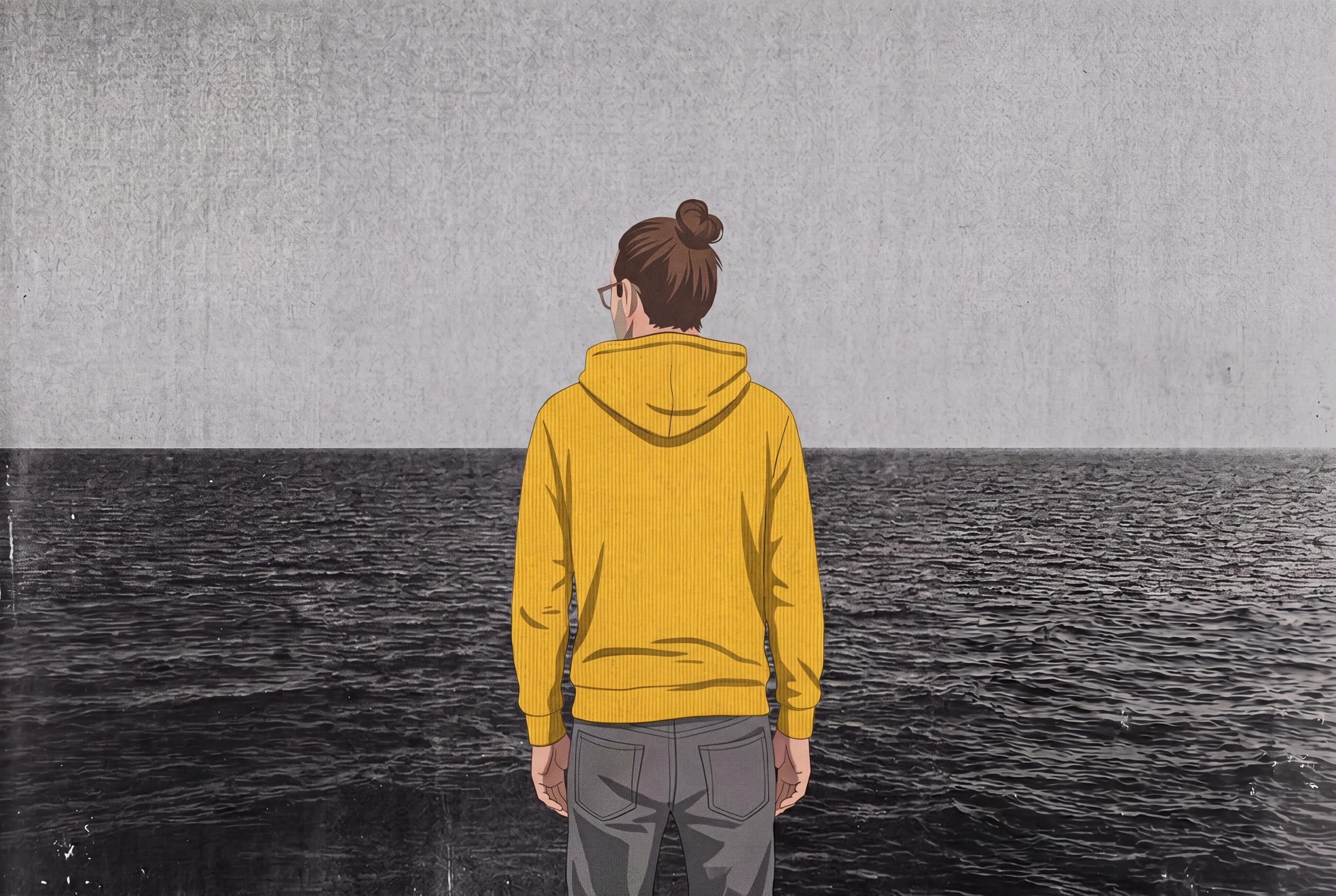
It feels like I can see the edge of the earth. The infinitesimally thin line where the sea meets the sky remains unwavering despite the throbbing rhythm of billions of tonnes of water. The sky is grey, and the water too. This is England after all. My toes are safely placed on terra firma, a few centimetres from the inept edge of the wave retreating to its source.
I need this.
To the London-centric, or the die-hard city dweller, the very idea of not being there is backward, provincial, and lesser than. In some way, a surrender or a failing. Well, I’m here to tell you it’s not. There are benefits that you can’t imagine, and there’s a reason why millions and millions of people have chosen a different life. The biggest exodus has been in the creative class, so if that’s you, and you’re thinking of making a change, my simple advice is to do what you want, not what you’re told.
YOU CAN TAKE THE BOY FROM THE COAST, BUT YOU CAN’T TAKE THE COAST FROM THE BOY.
After a decade in the capital, I left London in 2014 to return to the coast. The city has no horizon, and in day-to-day life, there’s no way to walk to the edge of things, look into forever and daydream. The insular experience of being disconnected from nature and the planet itself is so subtle that it’s easy for a metropolis to hide it. I longed for expanse, and whilst I lived there, I needed to leave every few months.
Every single time that the train pulled out of Waterloo station, I’d feel a physical weight being lifted off my shoulders. As I rolled back into the station on my return, there was no mistaking the feeling of the burden being put back.
I have a theory, hear me out. We have a left brain and a right brain. The myth is that one side is linguistic, and the other is pictures. One is analytical and the other creative. But actually, we now know that’s rubbish; all the brain is involved in everything, but the hemispheres are different. The left side is hyper-focused, laser sharp, tight. Get the food, eat the food. The right side is broad and open, a wider awareness, scanning the periphery for danger. My idea is that city life locks you in the left. Life outside it feels like the right.
GOING BACK TO GO FORWARD
To understand why I left, I probably need to explain how I ended up in London in the first place.
The year is 2003, and I’m a young painter who’s had a couple of shows in London but still paints from my spare bedroom in Dorset. I’m sitting on the floor in Derring St as the gallerist who arguably wrote the rulebook for the London art scene handed me a stack of Warhol drawings of shop windows. To my right, a Damien Hirst (who started off as a technician for the gallery) sheep in a vitrine, to my left a huge Ron Mueck head and in front of me a series of Warhol portraits of Beuys.
Anthony d’Offay was quiet, contemplative and kind. He’d just stepped off the gallery treadmill and closed the biggest gallery in town. I’ve always admired him for having the courage to leave whilst at the top. I also know that subtly, behind the scenes, he’s helped more artists and more galleries to bring art to more people than almost anyone else. When he shut shop, his personal collection became the property of the nation, and it’s due to Anthony that everyday people across the UK can see seminal, important work by the likes of Mapplethorpe, Hirst and Warhol in regional museums as part of his Artist Rooms donation.
“Anthony, how on earth do you sell these?” I asked. “I’d want to keep them all.” He simply explained, “I’m an art dealer, it’s my job,” before changing the subject.
“My boy, we need to get you to London.” I looked back uneasily. There was no way I could afford to do that; I barely scraped together the train fare to come and meet him in the first place. “If Tracey can make it here from Margate, you can get here.”
IF YOU CAN MAKE IT HERE, YOU CAN MAKE IT ANYWHERE
And get there I did. With the support of a couple of people who really believed in me and Anthony’s belief in my work, within a couple of months, I found myself in a loft in East London. One chair, a dying Dell laptop and a back-ache-inducing futon.
I’d never felt so lonely or isolated. Weeks would go by without really speaking to anyone. I became the weird guy in the bus line who would spark up a random conversation.
Where I was from, everyone said hi to everyone. Here it was a bit different, but I had my work for company and took Anthony’s advice to keep my head down.
A decade passed, faster than I could ever imagine. One thing led to another. I’d had a series of shows in London, moved studios a couple of times and made some real friends for life. I’d made a lot of work, looking back on it, very little that I loved, and I’d travelled for shows in Milan, New York and Hong Kong. I met my life partner, had a boy, wrote for an art magazine and even directed the programme for an art gallery.
On paper, I’d made it, but inside, I was unhappy. I was still a fish out of water. I never really belonged in that life. I was always visiting, and there was always a gnawing calling to go home.
I get it, some people’s work is inspired by urban living, the city itself, being in the thick of it. Mine never was.
There’s nothing special about moving to a big city for work, either. Loads of people do it every day. I don’t regret it, and I’d definitely recommend it if you can. There’s no doubt it laid the foundation for the work I’ve made since. However, it’s not the 90s anymore. We don’t need to arrange to meet people at a fixed location at a fixed time and hope they show up; we’ve got mobile phones. We don’t need to frequent the right bar to be part of a scene. We have global networks online. And we don’t need to look people in the physical eye to collaborate with them.
EXODUS
In 2014, lots of people started leaving London. The art scene had changed. Nothing in East London was ungentrified. The ‘real artist loft’ had gone from something we cobbled together from anything we could find, to web developer chic pads, to Foxtons rental traps for bankers to blow their bonuses on. The spirit of collaboration was replaced with one of competition. At the start, it was artists in it together, supporting one another, helping where we could. Most of the bigger artists had already left my building. Doig was in Trinidad, and Ofili too. Annie and Idris were there, although we never met, and Raquib Shaw had some kind of jungle going in the basement under me, which meant I never needed any heating in the winter, until he moved out. Other friends of mine headed to Berlin, and those who worked in fashion, film or photography found themselves in LA, where they said they could actually get paid.
THE KNOCK
We’d just done a big show at Selfridges during Frieze. The opening was the previous night, and we got back late after accidentally dropping a pot of paint in the street outside, as we got out of the Addison Lee; that bright pink paint splat is still there.
The studio was chaos, bits of stuff everywhere. The ground floor overlooking the canal was where we worked, and above that was a mezzanine, where I slept. The glass frontage overlooked the canal and provided little protection from the honking Canadian geese in season, which guaranteed little to no sleep. Suddenly, a knock on the door foreshadowed a middle-aged gentleman in an ill-fitting woollen suit with a leather folder. I went down in my pyjamas. “Do you live here?” he asked. “Yes,” I smiled back. He handed me a piece of paper that would change everything. I had 30 days to leave, or I’d need to pay tens and tens of thousands in fines.
The issue was that the studio was never a live-work. The landlord told me it was, my lease told me it was. I was paying for a live-work. The council had other ideas. I wasn’t allowed to live in it, and they’d be back to check. The deal with the landlord was iron-clad; live there or not, I still needed to pay to the end of the lease. Maybe it was time to head home.
PACKING MY BAGS
I knew it was the work that was sustaining me, not the city. And the fact was, very little of what was going on had anything to do with London at all. For the last few years, almost everything I made was going overseas, and the galleries in NY, Milan and HK were keeping me busy. So I didn’t really need to be paying Zone One prices to express myself anymore.
One of the biggest lessons I’ve learned over the last couple of decades is knowing when to walk away. Every gambler knows that on a long enough timeline, the casino always wins. And quitting when you are ahead is the only answer; however, it takes courage, and leaving a relatively successful career in London could look totally nuts to well-meaning people.
My business manager told me disparagingly that “moving out would be the kiss of death, and that I’d lose everything”. Maybe he was right, maybe I would lose that life, but maybe I wasn’t there for that reason in the first place. As Paul McCartney said outside court when he got busted for growing weed in his greenhouse, he didn’t mind going to prison as long as he had his guitar. I didn’t really care where I was as long as I could paint.
DE-LONDON-IFICATION
We know that people living in London are the minority, there are only 16% of them, and the rest of the population is spread over the country. The BBC moved out of the city to Manchester, and the Arts Council have ploughed a fortune into supporting arts and culture outside the capital. Tracey Emin moved back to Margate and fostered a cultural rebirth. Jake and Dinos left, Jake to Hastings and Dinos to LA. Damien Hirst always had his place in Devon, and his mega-studio is in Stroud. When the pandemic hit, and people found out they could work remotely, it wasn’t so weird to choose another life. Bruton, The Cotswolds, Margate, St Leonards, Manchester. All absolutely heaving with a creative class who can quite literally do their thing from anywhere. And the word is, it’s worth it, life is better.
CREATIVE HORIZONS
As I look out across the harbour, the lapping of the waves threatens to freeze my toes. I remember that this was John Lennon’s favourite view on earth. He’d stay in Sandbanks with his Aunt Mimi, in fact, his OBE would end up on top of her telly. Poole has been my home too, for over a decade. This coastline has something about it that you can’t quite put your finger on. PJ Harvey lives by it, and there’s no doubt it fuels what she makes, too. Tolkien looked into it and wrote The Lord of the Rings. Robert Louis Stevenson imagined Treasure Island. Hardy’s cottage isn’t far away. Lucian Freud pulled his pants down in nearby Bournemouth Square and got chucked out of school, and Beardsley made some of his most shocking work here.
WHAT’S IT LIKE?
It’s a lot more relaxed. I feel like I have time to think and breathe, and my work doesn’t need to be rushed. I feel like I’m making better work. I’ve been able to give my son a connection with nature and a childhood that wouldn’t have been possible in London. Technology means I can collaborate with people all over the world. In fact, I’m sure I’m having more interesting conversations with more people than I ever would hanging around at private views in London. There’s no getting away from the fact that it’s much less expensive; we are in a cost-of-living crisis after all. And there’s a real sense of community, an actual neighbourhood, and I’m convinced that it has health benefits that we don’t yet understand.
FEARS TURN TO DUST
As for my business manager’s fears, they turned out to be wrong. I never left London as some career move; I did it for the work, but it was only once I’d gone that things seemed to open out properly. I carried on having solo shows in London, then in places like LA and Hong Kong, and found myself working with museums too, including Dulwich Picture Gallery. Public projects came in from places like Melbourne and Denver, and Happy Clouds turned up in Hong Kong, Toronto, Dublin and even Moscow. I somehow found the headspace to write my first book, and in a strange accident of fate, I also started making art materials for other artists, which grew into something that has now sent more than half a million paints out into the world.
What really surprised me was that the traffic didn’t only flow one way. With help from the Arts Council, I ended up founding a public gallery ‘GIANT’ in my hometown, bringing major international artists back to the coast I’d grown up on. And while everyone tells you that you have to go to London, I started seeing the opposite happen too, artists leaving it, and even people coming from overseas to work with my studio by the sea. That was the point I really understood it. Leaving London hadn’t taken me away from anything. It had given me the space to build something bigger on my own terms.
If I can do it from here, you can do it from anywhere. Your creative voice is best used where you feel most like yourself. I know if I had stayed in the city, I’d have died a slow death of burnout, and my perspective would have narrowed. When you step outside it, you realise you’re part of something much bigger.
Don’t let anyone tell you where you need to live, or how you need to live. If they judge your location as some sign of success or failure, they clearly haven’t got the memo that, as long as artists can express themselves, we’ll be perfectly happy anywhere.