


The Right Thing In The Wrong Place
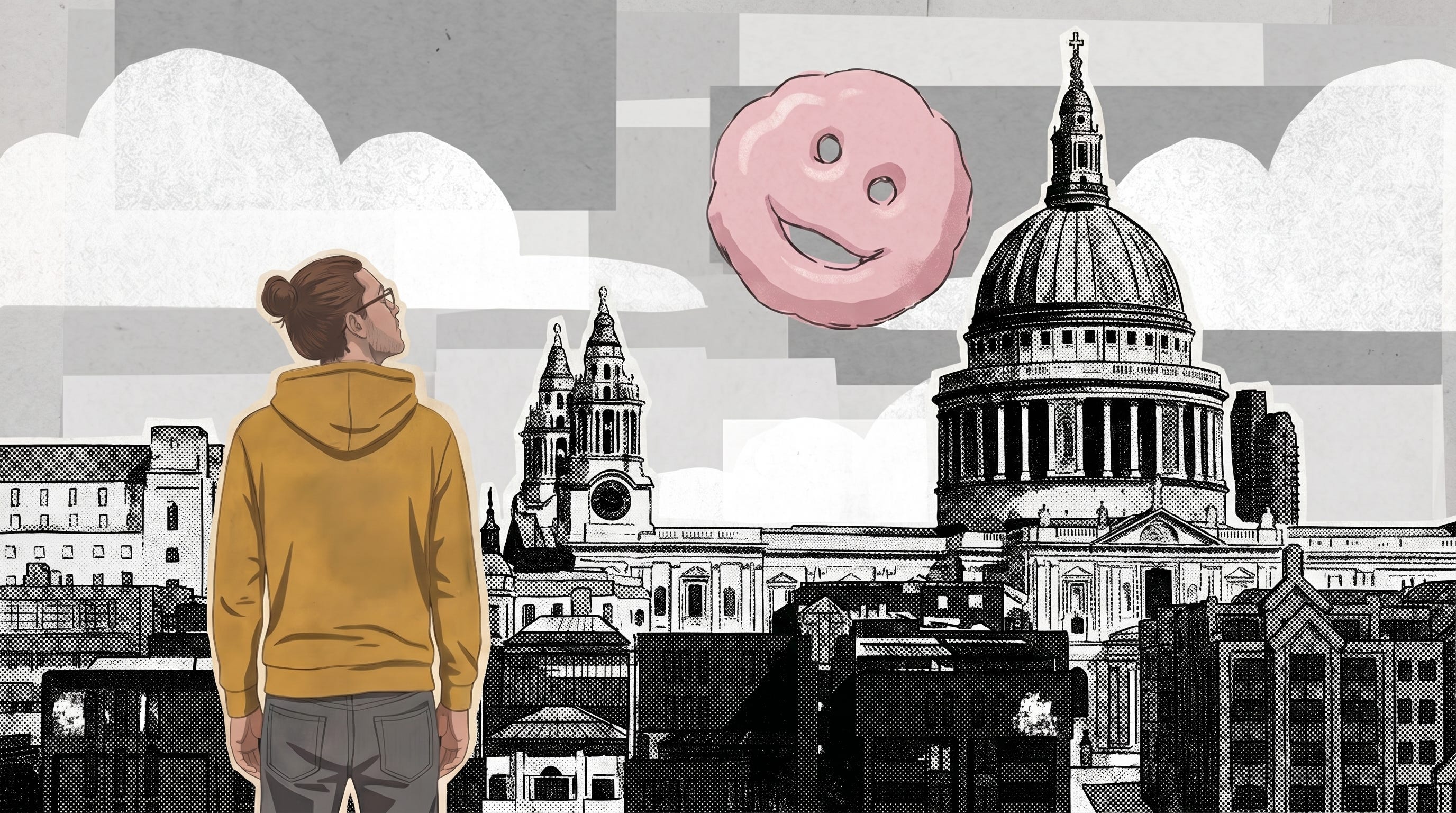
A huge bright pink cloud in the shape of a smiley face floated through London’s grey skies from Tate Modern towards the financial district.
And that’s when it hit me. The artwork wasn’t the cloud.
Looking back, I think I’d accidentally stumbled across a secret. One that Marcel Duchamp understood. One that Andy Warhol understood. More recently, Hilde Lynn Helphenstein understood it too through her Jerry Gogosian persona.
For years I’d called it “the right thing in the wrong place”.
Put an object where it doesn’t belong and suddenly people see it differently. Put a smiley face in the middle of a financial crisis and something shifts. Put a dog comb in an art studio and people start asking strange questions. Put a satirical character inside the art world’s social media ecosystem and watch the whole thing squirm.
But the cloud over the Thames made me realise something bigger. What if the most powerful art isn’t art that points at a system? What if it’s art that gets inside one?
The actions, objects, characters and images created by Duchamp, Warhol and Helphenstein weren’t simply artworks. They were Trojan horses. They slipped into reality disguised as something else and, once inside, started pulling at the controls.
What dawned on me that day changed the way I think about art completely.
I want to share it with you because I genuinely believe this idea has the power to help artists do more than just make things. I think it can help us change things too.
THE GREAT RECESSION OF ‘08
Day after day the newspapers screamed “DOOM AND GLOOM” and offered tips on what to eat for a “CREDIT CRUNCH LUNCH”.
The country around me was already grey most of the time. It had a natural tendency towards dissatisfaction and a long tail of quiet desperation. Then 2008 arrived and the whole thing seemed to collapse in on itself.
People were storming the banks for their money and the banks didn’t have it. House prices were in freefall. The city kept its usual stiff upper lip even though it had its head in its hands.
My main dealer shut shop. He’d lost everything in an over-leveraged dance of blue-chip art and blind faith in Bernie Madoff. One minute he was buying and selling paintings. The next he was cashing in prime Chelsea real estate for a one-way ticket to the sun.
Eventually the crash hit me too.
All my projects disappeared, my studio went and my assistant needed to look for another job. I wasn’t alone. Woolworths went. Borders went. Even Lehman Brothers collapsed.
Art is always one of the first things to be sacrificed when times get hard. In the payment pecking order it’s considered a luxury. The glitter on top of the cake.
The irony is that when the world kicks, art is often the thing we need most.
Technically I became homeless. One of the many hidden unhoused. I showered at a hotel gym and slept on a sofa in a building I wasn’t supposed to be in. I had a three-month-old son, no heating, no hot water and a constant fear that social services might decide I wasn’t fit to be a father.
I became very good at pretending everything was fine.
Up until then I’d been making paintings about society. I pointed at systems like religion, class and the media and tried to work out how they functioned. Looking back, it was all a bit naive.
I thought art’s job was to hold up a mirror. I had no idea it could do something far more powerful.
SYSTEM ADDICTS
It’s nothing new for artists to be fascinated by the systems around them. Back in 1968, Jack Burnham wrote an essay called Systems Esthetics that almost predicted the moment we’re living through now. He imagined a future where artists would become less interested in isolated objects and much more interested in what was happening around those objects: systems, networks, relationships and flows of information.
More recently, Ben Davis wrote an article for ARTnews called The 21st Century’s Biggest Art Trend Is Not a Style. His argument was that Burnham’s prediction had essentially come true. Rather than being defined by a visual style, a huge amount of contemporary art is now concerned with how systems work: media systems, financial systems, housing systems, museum systems, technological systems and political systems.
The tricky thing is that, unlike Cubism or Abstract Expressionism, Systems Art doesn’t have a defining visual language. You can’t walk into a museum, point at something and say, “That’s Systems Art” based on what it looks like.
Because Systems Art isn’t really defined by appearance. It’s not about what something is. It’s about what it’s about.
SCUMMY SLUMMY LANDLORD
Let’s take Hans Haacke, because he’s one of the key figures Ben talks about in his ARTnews piece.
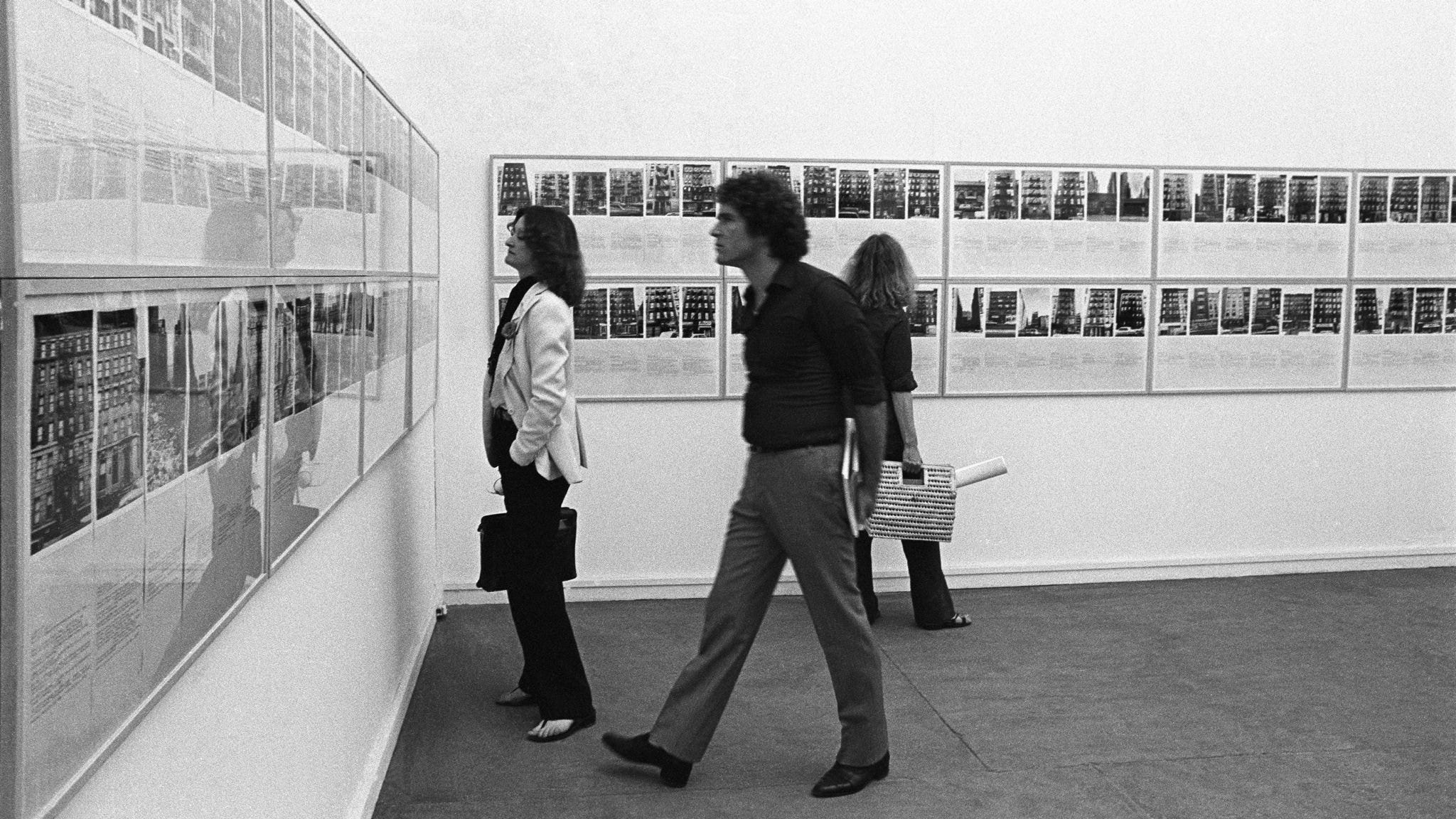
A famous example of his work is Shapolsky et al. Manhattan Real Estate Holdings, A Real-Time Social System, as of May 1, 1971.
In this piece he spent years researching a notorious slum landlord in New York. He mapped out the shell companies, who owned what, and all the hidden structures behind a sprawling property empire. The artwork revealed all of it. It’s a brilliant piece consisting of more than a hundred photographs alongside texts, records and documents exposing the shenanigans.
Visually it couldn’t look more non-art. As you approach it, you’re greeted by a wall of black-and-white photographs of fairly ordinary New York apartment buildings. Nothing spectacular. No dramatic composition. No painterly flourish. Just straightforward documentary photography.
Next to them are maps, charts, property records, ownership documents and typed information panels.
The whole thing looks less like an artwork and more like a covert investigation. A bit like the evidence wall in a detective’s office, or a journalist’s research pinned up while trying to expose a scandal.
RENEGADE PARKING PERMITS
Back in 2008, I was on a mission inspired by an American student who did a residency with me in the studio. One day she came in waving a newspaper cutting about someone who had turned a Hollywood snow machine into an eco-cloud maker.
I convinced Diana, my bank manager, to lend me £1,500. Receiving it involved me walking into a branch of Lloyds Bank, passing my phone to the cashier, Diana having a word, and that cashier handing me the money in cash.
For some reason that I still don’t understand, Diana believed in the hare-brained idea I had to make an artwork out of the doom and gloom. Neither of us had a Scooby what would actually happen.
I’d already applied to the Metropolitan Police for permission to stage a protest against doom and gloom. The plan was simple. I’d be on the South Bank with a box and two helpers for a couple of hours.
Permission was granted and I was sent a certificate saying it was all cool to carry on.
The next part of the plan was harder. I needed somewhere to park a massive truck and a way to get a big box of tricks outside Tate Modern.
The problem was that, post-9/11, nobody was going anywhere near a cultural landmark with anything that looked like the kit I had without the eye in the sky hitting the red alert button.
It turned out the Dean of Southwark lived in a little terraced house by Tate, just up from Shakespeare’s Globe. And his big cathedral had a fund to fix the roof.
A £100 donation from Diana’s spontaneous overdraft facility was all it took for the good old Dean to lend us the holy grail for a morning: a prime parking space. Front-row views of the Thames and easy walking distance from Tate Modern, even with the ridiculous machinery we had.
WHERE’S THE CHANGE?
The thing that bothers me is this: if Systems Art is so powerful, why doesn’t it seem to change the systems it highlights?
It’s not that it doesn’t change things. It does.
Haacke’s work changed the art world. It legitimised the place of data, research and economic material in art. There’s no doubt it inspired generations of artists.
The thing was, the system it changed was the one it existed within: the art world, not the New York property world.
Landlords were still landlords and the rotten machine kept running.
That’s where I part company with Burnham and Haacke because I think artists can go further.
Being a mechanic is fine, but being a mechanic who builds their own garage, makes their own tools and opens the doors to anyone who wants to learn is far more interesting to me.
Revealing a system and changing one are not the same thing.
INTO THE MACHINE
“The line between art and life should be kept as fluid, and perhaps indistinct, as possible.”
— Allan Kaprow
By now you’re probably thinking, “What the hell has all this got to do with Duchamp, poor Jerry Gogosian, Warhol and dog combs?”
Well, Duchamp was a total nightmare. Everything made so much sense before him. Afterwards, anything could be art: toilets, bananas taped to walls, unmade beds and sharks in tanks. The mere act of an artist presenting, rather than re-presenting, something suddenly made it art. Craft was out and utilising the real, ready-made stuff of the world was in.
But that wasn’t it at all.
Duchamp wanted much more than that. He wanted art to be life. A toilet in a gallery was still obviously art. The ultimate move was to pass art off as real life, undetected.
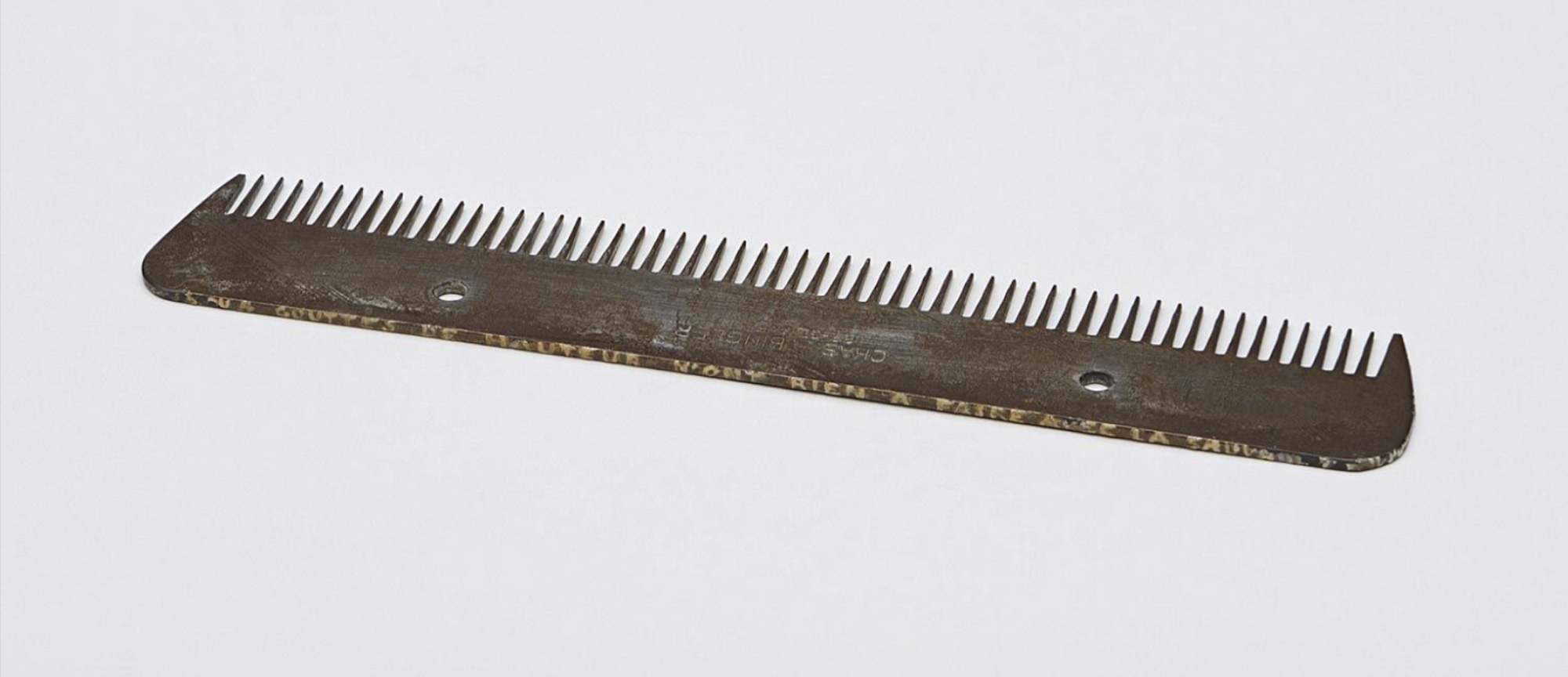
6Marcel Duchamp. Comb. 1916
The story goes that a notable critic swung by Duchamp’s studio and a metal dog comb sat on a shelf. The critic mistook it for real life, but actually it was art. We’ll never know if the story is true, but it’s easy enough to believe. Duchamp had a bottle rack and a snow shovel that were absolutely artworks, if you knew the secret to unlocking them.
The genius of Duchamp’s dog comb wasn’t that he turned a dog comb into art. It was that he made art behave like a dog comb. Visitors could walk straight past it without noticing. The artwork had slipped into ordinary life disguised as itself. Like all good Trojan horses, it got through the gates because nobody recognised it as a threat.
ANDY
So what’s this got to do with Warhol? Well, Warhol takes the idea to the nth degree. Yes, a Brillo Box, a soup can and an image of a movie star can be art. But he doesn’t stop there.
Andy doesn’t just create artwork for the Velvet Underground. He actually manages the band, injects them into popular culture, and nobody realises they’re part of Andy’s artwork. Malcolm McLaren would do it again later with the Sex Pistols.
That’s not the end of it. Rather than simply designing a magazine, he effectively built a publishing operation and produced Interview magazine, which is still going today. It is a magazine, but it is also part of Andy’s artwork.
Not to mention what he did with film. He didn’t just appear in movies. He built a film studio and distributed the films he produced.
Warhol famously said that “…business art is the best art”. What he meant was that even a business could become an artwork.
He didn’t critique systems from the outside. He made his mark from within them and passed that mark off as the real thing.
It really was a magazine. It really was a movie. It really was a band.
But that didn’t stop it being art. In a strange way, it made it more art than ever because they weren’t representing anything, they were actual functioning systems.
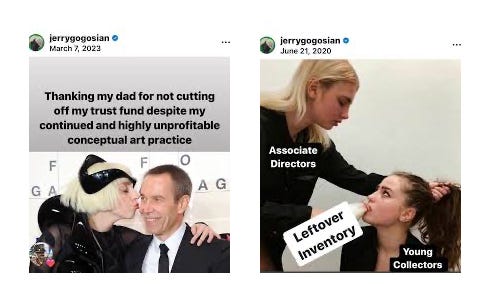
Hilde Helpenstein, Jerry Gagosian, instagram posts.
Jerry Was There
As I write this, social media feeds everywhere have erupted with posts about Jerry Gogosian. Very sadly, Hilde Lynn Helphenstein, the artist behind Jerry, isn’t here anymore.
None of us will ever know exactly why she’s gone.
What I do know is that she cared deeply about artists, fairness and the health of the art community. She felt things intensely. Artistic injustice, however distant, somehow became personal to her.
The thing is, Jerry Gogosian was a post-systems artwork. It really was a social media persona and that persona was the artwork.
It lived on Instagram. It was real, but at the same time it had an agenda. Its mechanism was satire. Hilarious, memetic, close-to-the-bone observations with uncomfortable truths baked into them.
These bite-sized posts had all the ingredients for viral success, but hidden inside them was a desire to provoke change.
Some people thought Jerry was real. Others understood she was a character, a piece of social sculpture created to poke, prod and occasionally ridicule the art world’s sacred cows.
As Jerry grew, something strange happened. People stopped responding to the artwork and started responding to the person.
The distinction between Hilde and Jerry became blurred. Criticism aimed at the character could still wound the human being behind it.
The artwork had become real. Or perhaps it had become too real.
The posthumous tributes describing Jerry as “an influencer” completely miss the point. She wasn’t. She was an artist hiding in plain sight.
Duchamp hid art inside a dog comb. Warhol hid art inside a magazine, a band and a film studio. Hilde hid art inside a person and that’s why Jerry mattered. And that’s why I’m going to miss her.
Mark Fisher wrote about capitalist realism, the idea that it’s easier to imagine the end of the world than the end of capitalism.
The art world has its own version of this. It’s easier for a critic to imagine the death of painting than it is to imagine an artist’s company, magazine, social media presence or business being the artwork itself.
I think the closer art gets to reality, the more leverage it has over reality. And sometimes, perhaps, the greater the risk.
HAPPYCLOUD TIME
Back on London’s South Bank, we put the finishing touches to our contraption, connecting hosepipes and helium canisters. Across town, Anish Kapoor was about to unveil his addition to the Fourth Plinth in Trafalgar Square.
Before long, our first slightly wonky smiley hatched from the small van-sized box of tricks, floating up into the city’s grey expanse and starting its mile-or-so-long journey before completely evaporating.
Once we got up to speed, every few seconds a giant eco-smiley-shaped cloud looked as if it was emerging from Tate Modern. Luck was on my side. The wind that day happened to form a corridor aimed directly at the financial district. What a fluke. And what an unbelievable metaphor. The art was pouring out of the museum and sending its happiness into the city.
Then suddenly every news crew in town lined up to get a front-row view and capture images of what was unfolding. I’d accidentally stolen Kapoor’s thunder that day. Now, I’m not saying the man held a grudge, but I’m also not saying he didn’t.
Screw-faced business people shuffled along Millennium Bridge, clutching the weight of the world in their briefcases.
The monochrome backdrop mirrored their sorrow.
Then one of these massive happy clouds would casually float past their heads and, as if by magic, their whole expression would thaw. A cheeky smile would start to grow from the corner of their lips.
People in high-rise office blocks saw the clouds through their windows too.
It wasn’t until all of this was well underway that I started to realise what the artwork actually was.
It most definitely wasn’t the cloud.
IF YOU CAN’T BEAT THEM, JOIN THEM.
NO. IF YOU CAN’T JOIN THEM, BEAT THEM.
Sometimes you need to make your own world. Your own system.
Where I’m from there was no well-connected black book of contacts. No family trust fund waiting in the wings. If we wanted something to happen, we had to make our own luck.
There was a precedent for it. Before me there were illegal raves and artists throwing exhibitions in abandoned buildings. BANK, the art collective, became famous for it. Nobody invited them in or handed them a white-walled gallery. They found spaces, old gyms, empty swimming pools, whatever they could get their hands on, and put on shows. It worked.
Damien Hirst and his mates at Goldsmiths knew the traditional London art world was never going to understand them. So Damien threw a show in a warehouse, sent taxis to collect important people, and the rest is history. It became one of the defining moments of British art and announced the arrival of the YBAs. They showed the next generation that permission wasn’t required.
My first show in London was in an abandoned warehouse in Docklands too. My friends and family helped me clear out used needles, dead rats and the remains of a fire. We ran power from the illegal bare-knuckle boxing gym opposite, hired some portable loos, built a makeshift bar, bought terrible wine and hustled as hard as we could to get people through the door.
I didn’t know any other way.
Looking back, that instinct has run through almost everything I’ve made.
I’m interested in the invisible systems that decide who gets to make art, who has access to materials, who owns colour and what public space is actually for. But I’m not especially interested in simply pointing those things out.
I want to build alternatives and see if they work.
Sometimes they do.
Sometimes they fail miserably.
But I’d rather try to build a new door than spend my life describing the one that’s locked.
YOU CAN’T KNOCK THE HUSTLE
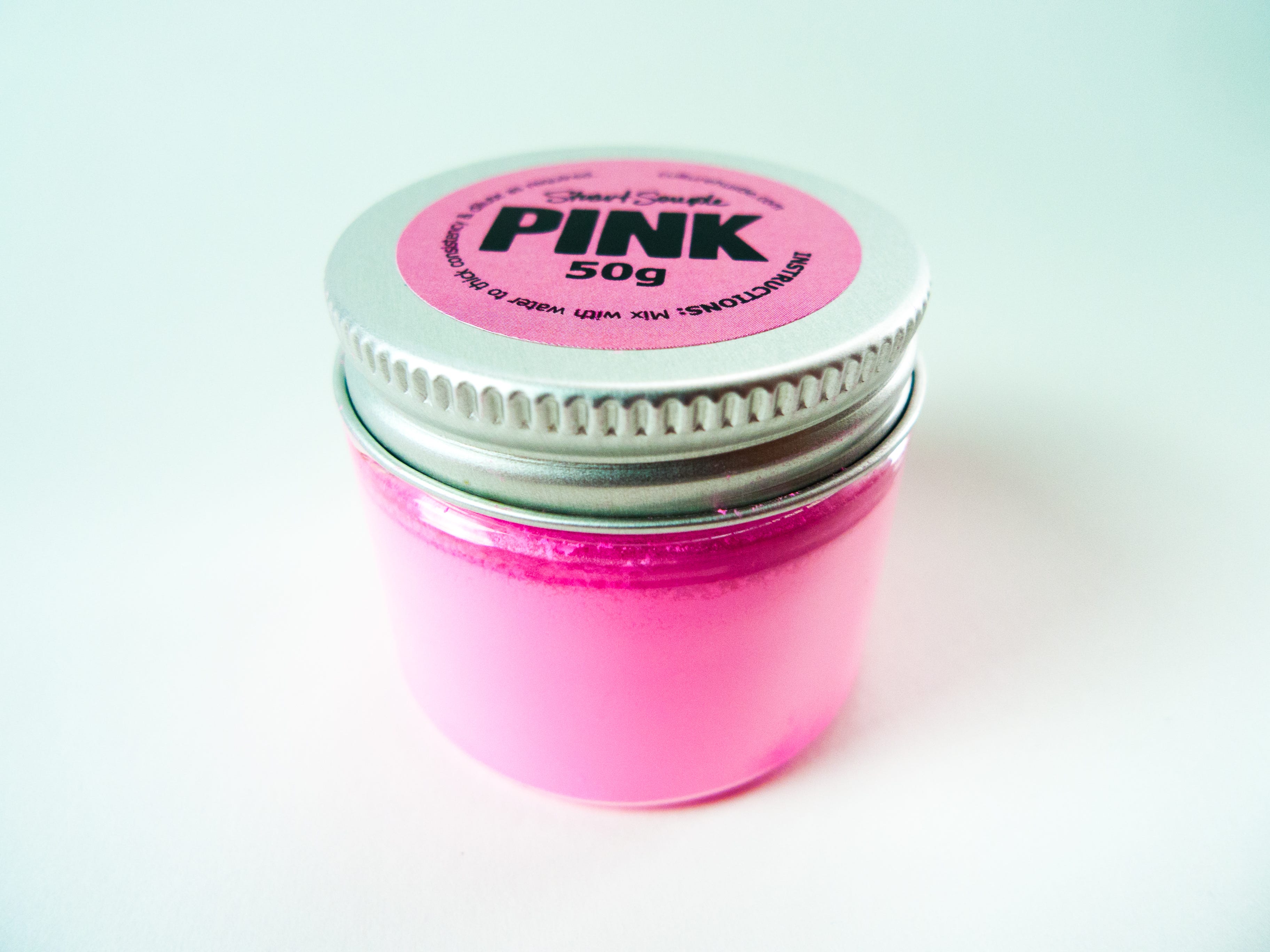
Pinkest Pink, 2016 (ongoing), pigment, plastic, aluminium and sticker.
In 2016, Anish Kapoor secured exclusive artistic rights to Vantablack, the world’s darkest pigment. One artist claiming ownership of a colour.
My response was to create the Pinkest Pink and make it available to everyone on earth for £3.99, which is what it cost me to make, except Anish Kapoor. On the website you had to agree to legal terms confirming that you weren’t Anish Kapoor and wouldn’t give him any.
The art press treated it as a stunt, a meme, a feud. It was none of those things. It was a systems intervention, and I really meant it.
Kapoor’s Vantablack deal accidentally exposed something the art world usually keeps hidden: access to the means of making is a power structure.
I’d spent my whole life being told no. I wasn’t born in a capital city, I went to the wrong college, I was from the wrong social class. Art wasn’t meant for people like me. Of course, I’m not the only one who’s been left out.
To exclude all artists from the use of a material whilst happily supplying jewellery designers, architects, car companies and marketing agencies exposed the elitism and privileged access that runs through the whole thing.
Rather than write an essay about it, I built an alternative.
Then I kept going.
The Pinkest Pink was followed by the Blackest Black, the most pigmented paints, the glitteriest glitter and eventually an entire company dedicated to making game-changing materials accessible to anyone who wanted them. My little studio has now sent more than half a million items to artists all over the world.
By total mistake it ended up becoming a company. We called it Culture Hustle. It’s very real, and it has had all the usual ups and downs, highs and lows, that you’d expect from any real business. Yet it’s still art.
The Pinkest Pink was a jar of pigment, but it was also an artwork about the system it found itself in.
What amazed me was that people bought it in the first place, let alone actually used it. I thought it would sit on shelves like a sculpture. Instead, over the last decade, my studio has shared enough of the stuff to paint a one-centimetre-wide line from London to New York and back again.
I sometimes wonder how many people who own it think of it as art. Secretly I hope it’s none. That’s the point really.
Culture Hustle isn’t separate from the artwork. Culture Hustle is the artwork.
We didn’t make the point to make the company. We ended up with a company that makes a point.
WHO DIED AND MADE THEM COLOUR KING?
Pantone is a system for matching colours. Every year it announces a Colour of the Year and much of the design world falls into line.
That never sat right with me.
So rather than complain about it, I built an alternative. A democratic version where anybody can vote for the People’s Colour of the Year. It’s called colouroftheyear.com.
It’s a tiny example, but the principle is the same. Don’t just critique the system.
Build another one.
A REAL LIFE VIRTUAL MUSEUM
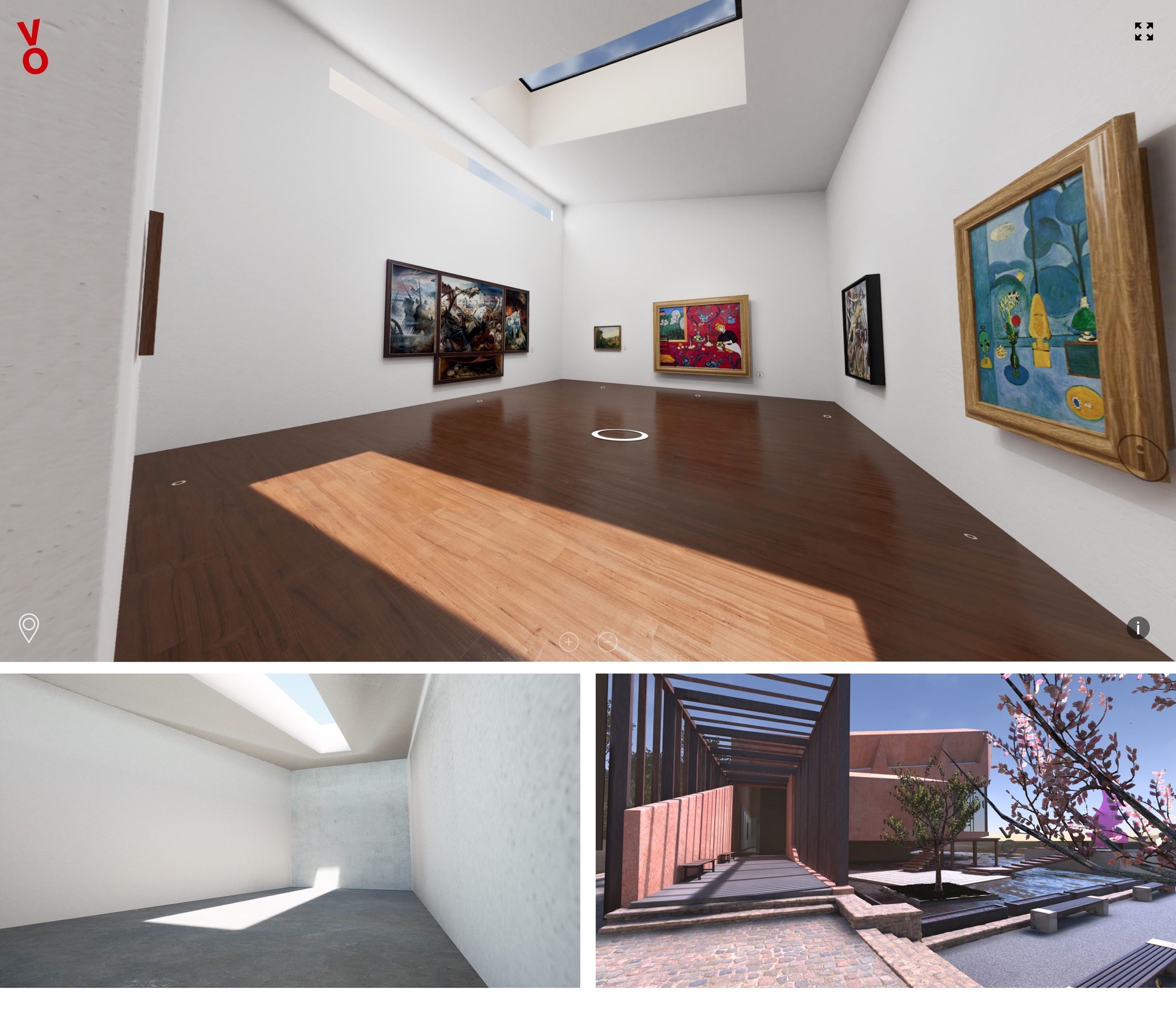
VOMA - with thanks to Corneel, Michael, Lee, Emily & Nat.
I love museums. Always have. The best ones do everything they can to make their spaces inviting, open and accessible. The problem is that museums are still systems. They have to decide who gets in, who sees what and how it’s shown.
Tracey Emin may have moved her bed into a museum and Duchamp his urinal, but artists still didn’t really get much say over the museum itself.
Then lockdown happened.
Suddenly nobody was allowed into museums. And it dawned on me that millions of people were excluded from them even before that. Travel costs money. Education can feel like a barrier. Some people simply don’t feel invited. Where I grew up, the idea of spending money to travel to London to look at contemporary art might as well have been the same as asking for a ticket to Mars.
So rather than moving art into a museum, I wondered what would happen if we moved the museum itself.
Everything was shifting online. Zoom had become the new meeting place. Houseparty was where people hung out. The technology was finally there.
I teamed up with an architect, an incredible game artist, a brilliant curator and the best software developer I could find. Together we built VOMA, the Virtual Online Museum of Art.
For a few years we ran a real museum. We staged exhibitions, borrowed works from major collections, hosted talks and panel discussions, built a reading room and welcomed visitors from anywhere in the world for free.
The technology wasn’t perfect and perhaps we were a little early.
But for a while, at least, we didn’t critique the museum system.
We built another one.
A GIANT GALLERY
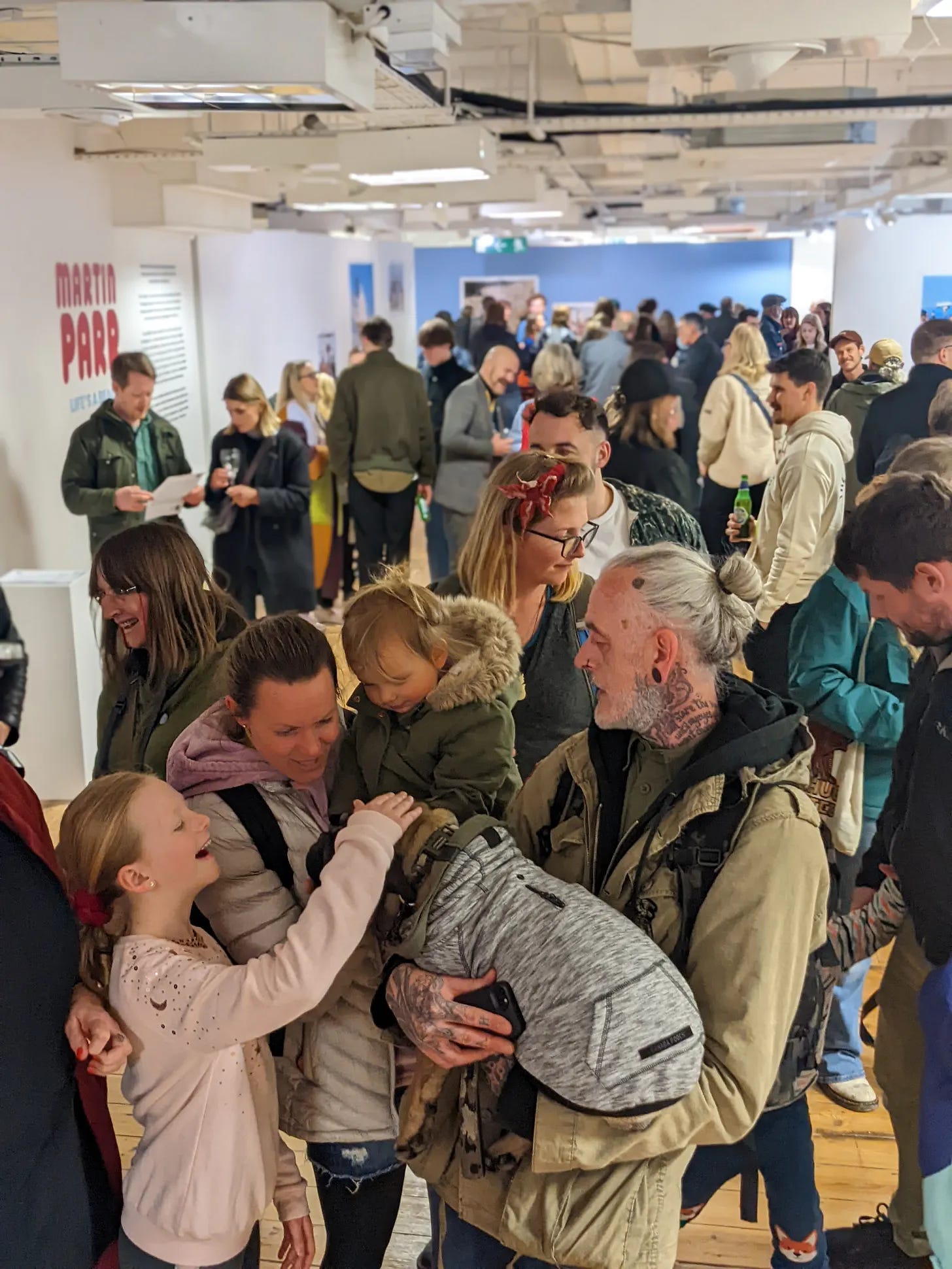
Martin Parr opening, Giant Gallery.
GIANT is perhaps the clearest example.
I took a dead Debenhams department store in Bournemouth, a casualty of one system (high street capitalism), and repurposed it as infrastructure for another (artist-led culture). The Arts Council thought it was important enough to support, as did my local council, and I put my own money into it too.
During its two-year run it became one of the largest artist-run galleries in the UK. We hosted around 30 exhibitions and gave people in a small seaside town access to real work by major living artists, alongside newer voices, right on their doorstep and in an environment that wasn’t intimidating.
More importantly, it welcomed hundreds of thousands of visitors, ran a full educational outreach programme, created real jobs in the cultural sector for people who might never otherwise have had the opportunity, and provided a platform for artists and creators to bring their ideas to life.
It was always intended to be temporary. The landlord would eventually need the space back and the funding was never going to last forever.
When the time came to close, we filled it with as much art as we could and gave artists at every level the chance to put their work on the wall.
Looking back, I realise I’ve been making the same artwork over and over again.
Culture Hustle, VOMA, GIANT, Colour of the Year. On the surface they look completely different. One is a company, one is a museum, one is a gallery and one is a public vote.
But the underlying impulse is exactly the same.
Each started with a system I thought could be more open, more accessible or more democratic. Rather than complain about it from the sidelines, I tried to build an alternative and see what happened.
Sometimes it worked and sometimes it didn’t. Either way, I’d still rather try to build a new door than spend my life describing the one that’s locked.
HIJACKING THE SYSTEM
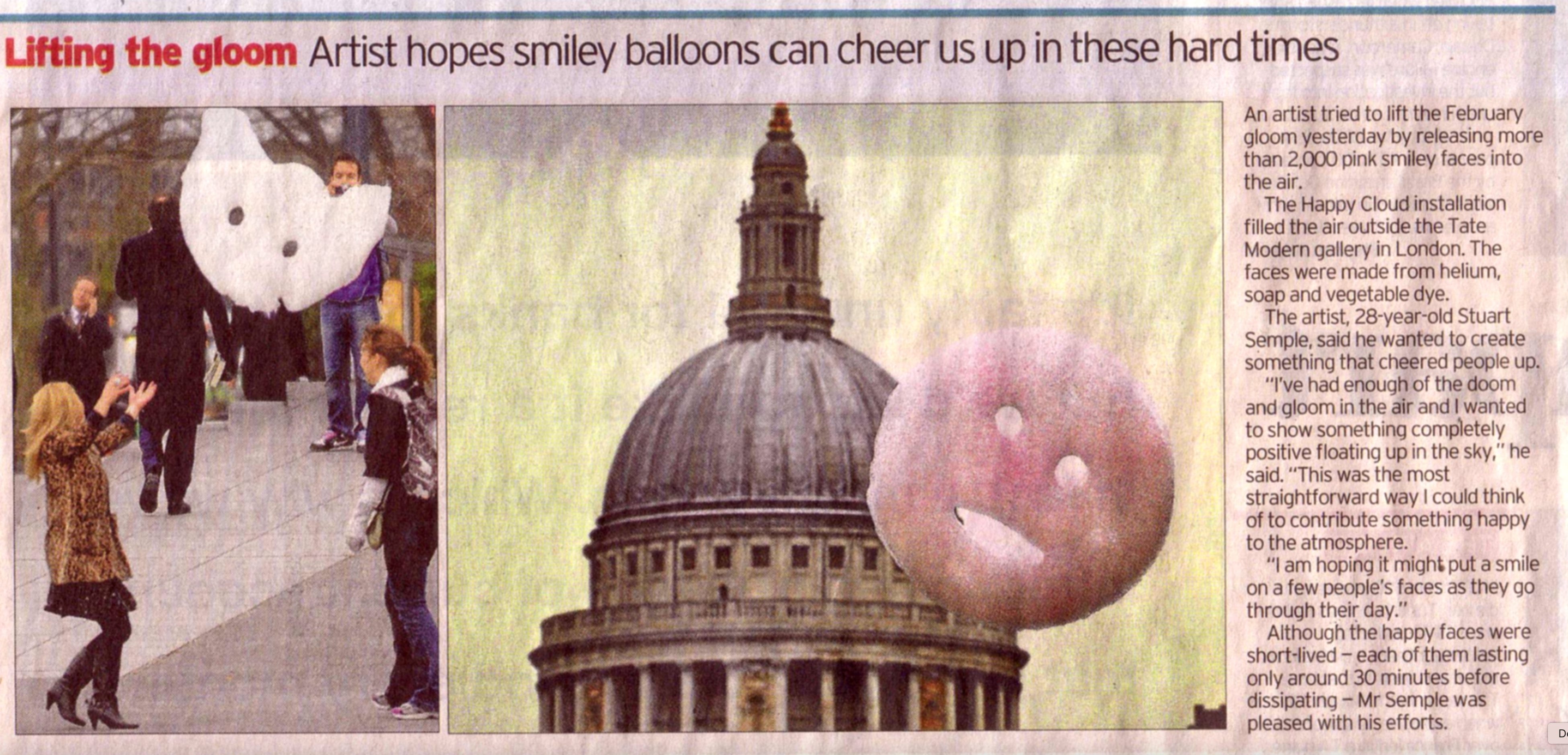
Whilst the world was falling apart for a lot of people in 2008, the thing that bothered me most was the way the media reported the carnage.
We’d all got the message. Things were bad.
The constant rolling gloom wasn’t helping anyone. The public didn’t need a relentless stream of pessimism, it needed a break.
What was the point of having millions of people reading newspapers and watching the news if nobody was going to put something uplifting in them?
And where were the artists? Had they forgotten their voices had power?
That night something strange, and completely unexpected, happened. Millions of households tuned into the 9 o’clock news and found themselves staring at a giant smiling cloud.
The next morning newspapers carried images of happiness on their front pages. Before long publications from Moscow to Korea, and everywhere in between, were asking me to send them photographs too.
Admittedly it was a flash in the pan. The doom media soon resumed its usual battle march.
But the lesson was loud and clear. Whilst I was focused on the cloud, the artwork was the system the cloud had entered. In this case, the media.
For a brief moment, art hadn’t commented on a system. It had changed one.
That realisation altered the course of my practice. I began to understand that art didn’t only have to point out flaws in systems. It didn’t only have to expose them or critique them. Art could operate within them and it could infiltrate them. And sometimes, however briefly, art could change them.
Over the years people have invited HappyClouds to their cities, museums and neighbourhoods. It’s drifted across Moscow, Hong Kong, Dublin, Toronto and Colorado.
It may no longer be guerrilla. But it’s no less Trojan. And it still seems to make people smile.
MISSION IS POSSIBLE.
Obviously the game these artists were playing had very little to do with where things were placed and much more to do with the systems they were placed inside.
Duchamp understood it. Warhol ran with it and Hilde understood it too. I’m still wrestling with it all.
That’s the thing I think Burnham and the Systems Artists only got half right. Revealing a system is important. Understanding a system is important. But if all you ever do is point at the machine, the machine keeps running. It’s not enough to know how something works. At some point you have to get your hands dirty and try to build something better.
If you want to change the water system, don’t make a painting about the water system and hang it in a museum. At best you’ll end up changing the museum. You’ve got to build a water company. Build a treatment plant. Build an alternative.
And whilst you do all that, you don’t have to stop being an artist. That’s the biggest misconception of all. People talk about art as if it’s a job description or a skillset. As if being an artist is something you switch on in the studio and switch off again when you go home. But it isn’t. It’s something you are.
Once you understand that, everything becomes available. You can be an artist making a painting and you can be an artist making a business. You can be an artist writing software, running a gallery, building a museum, starting a school or raising a family. Artists can do anything any other human being can do. The difference is that artists have a habit of seeing things differently. They can use all of those things as materials.
That’s where I think this all leads. The most powerful systems art doesn’t reveal systems. It becomes them. The company becomes the artwork. The museum becomes the artwork. The gallery becomes the artwork. The system itself becomes the medium.
The last thing the world needs is another picture of a locked door.
It needs someone to make a key.
Then make enough copies for everybody.